Soooooo you guys, I'm writing a book.
A while back Chris floated the following idea for a romance novel: "She's a 19th century schoolmarm whose schoolhouse turns out to be built on top of the mother lode. But which man can she trust with her fortune (and her heart?)? Westley, the local railroad construction foreman, or Chan, the handsome but sensitive railroad worker?" I was really interested in the idea of a historical with an Chinese hero--there don't even seem to be many contemporaries with Asian/Asian-American characters. But the Transcontinental Railroad starting building during the Civil War, and I didn't want to deal with that, so I decided to work with the California Gold Rush, and have settled on 1852. Research ahoy!
The heroine has morphed into Charlotte Gray (née Martin, which didja know is the most common French surname? isn't that weird?), a young widow from St. Louis who lost her husband to cholera along the California Trail; instead of reaching San Francisco to open the dress shop she's always wanted, she is marooned in the mining settlement of Hapless Bar, mending jeans and contemplating the suit of the handsome but vaguely sinister Paul St. Clair. As it turns out, she looks like my sister, down to the sectoral heterochromia in her eyes (look it up, it's pretty).The hero is Lo Jin, scion of a once-wealthy Cantonese merchant who lost his fortune in the Taiping Rebellion, trying to strike it rich in Gum Shan. But when he and the other "celestials" are chased away from the diggings by white miners, Jin takes refuge in the root cellar of the boarding house where Charlotte lives, where she finds him and begins to smuggle him food, books...and companionship. (NUDGE NUDGE WINK WINK)
I can't think of the last time I was so excited about a project. The advantage of historical fiction for plot-challenged me is obvious: the more research I do, the more events are written for me, and I can concentrate on character, dialogue, and prose. I hadn't previously realized how little I knew about the Gold Rush; it's an amazing few years that changed so much, e.g. the population of San Francisco, which went from 1,000 in 1848 to 25,000 in December 1849. The settlements were crazy diverse, as well--for minor characters, I'll be able to choose from German, Irish, French, Mexican, various local Native Americans, Mormons, even Australians. I'm gathering names (Charlotte Gray was the maiden name of my senior seminar tutor, whose married name was Charlotte Martin; my mother's provided ancestors of the appropriate generation: Melchior Sebastian, Cundegunda Quade, Lucinda Weethe), local fruits & vegetables, contemporaneous fashion, and the thousand tiny details that make up a world.
And of course I've checked a quadzillion books out from the library. Three I already know I'll have to buy to keep around: The Writer's Guide to Everyday Life in the Wild West, The Writer's Guide to Everyday Life in the 1800s , and the incredibly valuable They Saw the Elephant: Women in the California Gold Rush, which I read straight through like a novel, fascinated by the copious journal entries and letters giving the words of some of the bravest women I can imagine. I'm gonna steal so many little things from these lives (like Lodisa Frizzell's badass name, and Mary Ballou's amazing turn of phrase "making coffee for the French people strong enough for any man to walk on that has Faith as Peter did"). And by "steal" I mean "use with modifications and include in an adulatory Further Reading Note," because I am not a jerk.
I'll admit: my word count so far is 773. But that's totes OK, because I'm aiming to have a good shopping-about draft by July 16, 2012 (a year from when I started), and the mad research-y rush I'm in right now is necessary, and fun, and won't last forever. I am grateful to have Theresa Romain to provide been-there encouragement (and I've read her upcoming debut, and it's delightful Austen-y goodness! more closer to the October pub date), and the supportivest boyfriend ever, full stop. I'll share any excerpts I'm particularly proud of, shall I?
Showing posts with label fiction. Show all posts
Showing posts with label fiction. Show all posts
27 July 2011

22 April 2011
Another stalled story.
I am soliciting feedback, queries, compliments, whatever--I know where this is going eventually, and I like what I have, but have been stalled for MONTHS. You'd think unemployment would be good for my writing, but it turns into one more failing. (P.S. Yup, it's sci-fi. V. excited by the prospect.)
They knew they weren’t the first. They were graduate students, after all, in an unpopular department at that; all the really exciting research went to the tenured and their lovers and lackeys, so all that was left for their group thesis was recapitulation. “The last botanical survey of the Forest was six decades ago,” Archon Venk had said, “and that wasn’t at all a proper one—they just sent some seercraft overhead, snipped some cuttings from the canopy.” Which they knew; there was a sickly bleakblade bush sitting in Venk’s office, brought back by a former dean and watered maybe once a semester. “It’s been two centuries since Fintzer’s original expedition.” Which was how they knew what the bleakblade was supposed to look like. Back then, seers could only draw their observations, and so almost all scientific illustration was an unsettling mix of crude and passionless; but one of Fintzer’s seers had had real talent, and she’d produced the inky, sleek images that gave the shrub its modern name. “You’ll have all the latest techniques, you’ll be able to study the biosphere as a whole, alive, instead of relying on recordings and specimens! It has the potential to be very exciting.”
They knew they weren’t the first. They were graduate students, after all, in an unpopular department at that; all the really exciting research went to the tenured and their lovers and lackeys, so all that was left for their group thesis was recapitulation. “The last botanical survey of the Forest was six decades ago,” Archon Venk had said, “and that wasn’t at all a proper one—they just sent some seercraft overhead, snipped some cuttings from the canopy.” Which they knew; there was a sickly bleakblade bush sitting in Venk’s office, brought back by a former dean and watered maybe once a semester. “It’s been two centuries since Fintzer’s original expedition.” Which was how they knew what the bleakblade was supposed to look like. Back then, seers could only draw their observations, and so almost all scientific illustration was an unsettling mix of crude and passionless; but one of Fintzer’s seers had had real talent, and she’d produced the inky, sleek images that gave the shrub its modern name. “You’ll have all the latest techniques, you’ll be able to study the biosphere as a whole, alive, instead of relying on recordings and specimens! It has the potential to be very exciting.”
On the lips of an administrator, potential was a sweet and hopeful word. Jaina, Lett, and Inar, however, were scientists (or hoping to be), and thus couldn’t help but be ruefully reminded of the physics sense of the word—how the politely-sipped cups in their hands, held against gravity, were full of potential energy as well as overbrewed tea; how that energy could indeed be dispersed with a crash and spill and shards, but instead simply whispered away as they filed out and placed them back on the cart. Similarly: sure, a modern expedition to the Forest might result in discoveries and prizes and professorships. More likely, they would only confirm previous data, cobble together a lackluster thesis, receive the lowest possible passing grade, and go on to work off their debt in windowless offices.
“Maybe I’ll have a garden,” Lett said morosely. “Or my co-workers will just come to me to diagnose their houseplants.”
“Like Venk’s bleakblade?” snorted Inar. “Nids. Hardy ones, too. I’ll bet they only ever get a drink when someone pours out that godawful tea.”
Jaina pushed open the door to their shared office, biting back her natural inclination to see the bright side. It was improbable that their trip would turn up anything new, anything to build a career on. Still, the Forest! She’d had a book of indigenous folktales as a child, and all her favorites took place there: Tej and the Flowerbird, the Five Lost Monks, the leave-the-light-on stories of the Blind Tiger and its deadly glare. The part of her that was still a little girl (the same part, she suspected, that had led her into botany because she’d enjoyed picking wildflowers) was thrilled at the prospect of standing among those ancient trees, listening to birdsong not heard for hundreds of years.
It was called The Forest not because it had never been named, but because it had been named so often; native records from as far off as Iothia spoke of dozens of attempted and failed settlements on its peninsula. Before that, folklore and ballads and proverbs referenced the Forest in unmistakable terms: bordered by a mountain range in the east, the ocean to the west, it was hard to reach and, it seemed, even harder to remain. Historians puzzled over this—indeed, the journey was difficult, but the soil was rich, and the easy access to the sea should have meant thriving trade for a port colony. Yet cultures and tribes had tried for millennia to establish such a town with no success, and though the documentation existed, it proved little logical help.
“Most of the legends are nonsense, of course, all monsters and massacres out of the blue.”
21 April 2011
Hello Kitty Boyshorts
The start of an abandoned short story. Let's call it a character sketch:
Nor, she maintained, was there immaturity to read into the seven or so pairs of Hello Kitty undies in her drawer: for one thing, they were mostly boyshort style, giving more coverage to the early-thirties female buttock than silly college-girl thongs. Also, the prevalence of Ms. Kitty on household décor and appliances (like her toaster, or her shower curtain) pegs her as part of adult culture. Also, the fact that increasingly she’s grown out of or given away her HK outerwear—hoodie, T-shirt, she thinks she had a skirt once—is definitely a sign of Maturity and Grown-up-ness, as she moves this beloved character into the realm of accessory (thus signaling her ancillary status) and privacy. She’d be less mature if she didn’t wear Hello Kitty underwear.
Lately she’d found herself invoking adulthood more and more, but in the most childish of ways: ice cream for breakfast, for one. A child’s urge to fill up on Rocky Road in lieu of food groups or the food pyramid or whatever they were supposed to be teaching in elementary school now but weren’t because there were standardized tests every week or so, right?—this was an irrational desire, predicated solely on the anticipation of pleasure. Whereas her early (not that early, to be honest) dairy intake was the result of sober and thoughtful decision-making, to wit: Cereal and milk is a totally legitimate Complete Breakfast, even when sugar is involved. What is ice cream, then, but a novel and creative substitute, and Rocky Road in particular, with its marshmallows and almonds, providing in addition good proteins and the fats they actually tell you to eat? The absence of grain is hardly a mitigating factor, as the modern American diet is lousy with carbs. But really, nachos, combining thus dairy AND grain, are an even more adult and responsible substitute for said cereal. Nothing immature about it at all.
Nor, she maintained, was there immaturity to read into the seven or so pairs of Hello Kitty undies in her drawer: for one thing, they were mostly boyshort style, giving more coverage to the early-thirties female buttock than silly college-girl thongs. Also, the prevalence of Ms. Kitty on household décor and appliances (like her toaster, or her shower curtain) pegs her as part of adult culture. Also, the fact that increasingly she’s grown out of or given away her HK outerwear—hoodie, T-shirt, she thinks she had a skirt once—is definitely a sign of Maturity and Grown-up-ness, as she moves this beloved character into the realm of accessory (thus signaling her ancillary status) and privacy. She’d be less mature if she didn’t wear Hello Kitty underwear.
09 April 2010
What I read instead!
The Gone-Away World, Nick Harkaway: YES YES YES. Like a dystopic Catch-22, full of black humor and tongue-dazzling wordplay, a great end-of-world-and-after scenario, and wonderful characters. Destined to be a classic--and unlike back-of-book blurbers, I do not use that phrase lightly.
Hotel Iris, Yoko Ogawa: I've read three books by Ogawa now (I think that's every one translated into English so far) and they've all been wildly different, but all stark and beautiful. This one is very dark, about the BDSM relationship between a 17-year-old girl and a man fifty years her senior. Point your mom towards The Housekeeper & the Professor instead.
The Boneshaker, Kate Milford: Middle-grade steampunk FTW! Full of creepy automatons, snake oil salesmen, and deals with the Devil, with an appropriately plucky heroine. Loved it.
Hotel Iris, Yoko Ogawa: I've read three books by Ogawa now (I think that's every one translated into English so far) and they've all been wildly different, but all stark and beautiful. This one is very dark, about the BDSM relationship between a 17-year-old girl and a man fifty years her senior. Point your mom towards The Housekeeper & the Professor instead.
The Boneshaker, Kate Milford: Middle-grade steampunk FTW! Full of creepy automatons, snake oil salesmen, and deals with the Devil, with an appropriately plucky heroine. Loved it.
28 June 2009
Long way round.
N.B.: I am not particularly happy with this review. It is maddeningly nonspecific, whereas the novel is awash in detail; it's impressionistic, where the book is sharply defined. It's also heartwrenching without being the least bit manipulative. I don't know how she pulls that off.
 The Scenic Route: A Novel by Binnie Kirshenbaum
My review
rating: 4 of 5 stars
I’m glad I finished this novel over a lunch break at work; else, I would have had to curl up someplace and bawl for a while. From the very beginning, The Scenic Route is about endings.
Sylvia Landsman, fortyish, divorced, childless, having been laid off from a job she didn’t care about, decides to go to Florence. There, she meets Henry, an expatriate whose marriage of convenience provides him with means and opportunity for a life of utter frivolity and leisure. Together, they set off on an aimless, luxurious jaunt through Europe, somehow outside of time and space, though conducted in five-star hotels and beholden to a deadline: eventually, Henry’s wife will return from her travels, to him, and he to her.
On long drives through landscapes, Sylvia tells Henry stories, rich expanses of unimportant detail, stretching back generations, while avoiding the uneasy climax of her most important story—the betrayal by omission of her best friend. But as she says, stories only have happy endings if you end them too soon, and the choices we make, though in many ways inevitable, are still our responsibility.
And all that makes the novel sound dark, doesn’t it? It’s not, though there’s plenty of grief to go around. Kirshenbaum’s facility with language locates beauty and humor everywhere, and the novel duplicates the process of getting to know someone so well that we’re ready to forgive Sylvia her cowardice, because it’s so like our own. “The Scenic Route” is that wonderful mix of wry, witty, and unutterably tragic—you know, like life. Where the destination’s known, but there are so many ways to get there.
03 April 2009
Medusa (short story)
[If I knew how to put this behind a cut, I would--it's long for this format.]
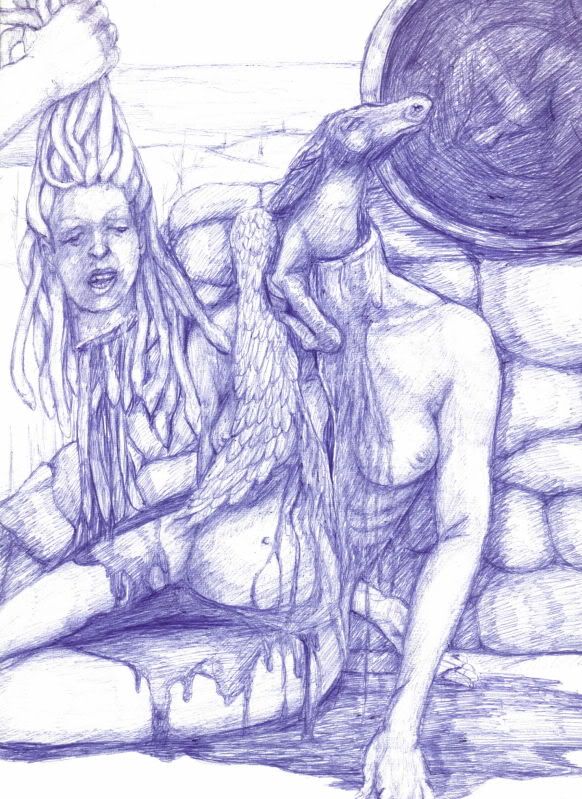
The wings had been inside her as long as she could remember. Mostly they were in her throat, when she tried to greet a neighbor or turn a phrase—beat, beat, beat, came the wings, and they blew out her breath so that she could not speak at all. When the storms came up from the coast, the wings hummed about her heart and stomach, and her mother would smooth her matted curls and coo quiet, and the wings would fold themselves away and lie still. When her mother died, the wings were everywhere—she was amazed that she stayed on the ground, stayed in one piece, for there were hundreds of wings beating her in a hundred different directions. She watched the flames from her mother’s pyre leaping, twisting, soaring to the skies, and the wings burned back in turn, beat, beat, beat.
The hooves came later, when she was eleven, kicking insistently at her chest until the flesh pointed and sagged and fell, heavy, towards the ground. They thrummed down her belly and beat like wings between her legs; she feared the coiled hair that began to grow there, feared that the hooves were driving out her guts. Then blood poured out, matting the hair, the hooves tearing her apart inside, and the blood ran down her legs. The wings came up behind her eyelids, and the tears came down like blood, and the blood came down like tears. The women of the household found her in the stable, on a clotted pile of straw, and they took her in their cloaks, in their arms, and cooed quiet. She tried to tell them of the hooves and wings but they did not understand. They told her that she was a woman now, that she belonged to them. But she knew that was not true. It was the wings and the hooves that owned her, that beat and kicked and changed her.
They took her to live at the temple. A motherless girl could not ask for more. If she could have formed the words in her throat, had it not been for the wings blowing out her breath, she would have asked to go to the temple of the Mother, to watch the holocausts and incense burn, the flames leap like wings towards the skies. But they took her instead to the temple of a god, not the father she had disappointed by the fact of her birth, but a young and handsome god, his statue covered in gold, with blue eyes like stormless skies to match the draperies his acolytes wove anew every year. She stood before him all in white, consecrated, and the hooves began to thrum below, remorselessly, on one small piece of flesh, sending flames up and down her skin that even the beating of the wings could not extinguish. She loved him. She would serve him well.
After that were days of ritual, of oil and chant and the stench of freshly killed oxen rising like flames before the god. She bowed her head as men passed by, come to the temple to pray for success in wrestling and lyre-playing; but she met the god’s blue eyes every morning, every evening, and felt the hooves thrum away till she feared the force would shatter her, cracks radiating out from the center, and she would fall to pieces like a dropped goblet.
She knew that she served the god well, more than just adequately, unlike the motherless mumbling girls beside her. She grew to look down on them, useless automatons; they spilt the oil, botched the chant, filched grapes from the god’s feast. The god would never love them as he loved her. She could fill a goblet to the very top so the strength of the wine was cut sweet with water, and she could carry the goblet high above her head, her hands wrapped in a white garment so her impure touch did not profane the god’s drink, and though she moved swiftly across the temple’s bright courtyard, not one drop of purple stained the cloth. Her length of his draperies was always a little finer than the others; she combed through the wool for hours, in secret, and palmed the best for her own use. Though she did not know the meanings of the chant—they were in a long-forgotten language known only to the high priestess—its vowels on her tongue tasted more familiar than ordinary speech. As the years passed, she looked into the god’s statue’s eyes every morning, every evening, and she could feel her love begin to pierce the stone, change the cold marble to living flesh, and she knew the god was looking back at her, not like a father, but like a lover.
So when the boy came, she knew what to do. She saw him first in all the crowd at the festival. He was perfect. Hair like gold, not just in color but in the way it bent and curled in the heat; eyes like stones made flesh. Hooves and heart and wings all leapt in every way at once, reddening her skin and causing such a headache her vision swam beneath the sun, though the boy’s outline remained clear. This was her reward, at last. Her love had brought the god to life.
When the boy looked up at her during the ceremony she looked out at him, pushing her desire through her pupils, fanned by the fluttering of wings. He did not seem the least surprised by her invitation. After all, higher-ranking women from this temple often entertained men during the spring festivals; how was he to know she was of common birth, unworthy of receiving a lover in place of the god?
That night they met in the cedars outside the temple’s stout columns. Without a work, they clasped hands and entered the sacred place to make love in the shadow of the god. Upon the altar she rode him as if she were going into battle. "My lord!" she cried, as her wings spread full, as she gasped at the updraft that seemed as if it would carry her away; as the wings spread wide, so that she could feel each individual feather, and she reached each one, separately, to the sky.
She awoke among the virgins, at the first caress of dawn, and walked down to the river to wash. She loved disrobing under the sun which was her god’s; she shuddered at its rays, touching her like a lover. As she stepped into the water, a bird left its perch in a nearby tree and flew, warbling its morning greetings, towards her. She whistled back with joy; the bird turned its head and looked her in the eye.
And fell, suddenly deadweight, into the water at her feet.
Immediately she crouched down to touch it; immediately she recoiled. For the bird, it seemed, had disappeared; in its place lay a perfect stone replica, carved beyond any master’s skill, exact down to the smallest headfeather, the clutch of its tiny claws, as if it had died of a fright so deep all breath had fled. But beyond the strange little statue, painted on the water, was a still more incredible sight: her head, her face, contorted in shock, surrounded by dozens of writhing, black-tongued vipers.
She screamed, screamed until the noise was outside of her and she blocked her ears against it. A viper slid between her fingers, and she screamed again. The bird’s body rocked from side to side in the ripples.
She seized a rock, one of the black jewels of the volcano god, and splintered it into wafers, sharpened it frantically on the boulders of the bank. Half gagging, she seized one of the snakes on her head by its throat, pulled it taut, and began to saw at it with the makeshift knife.
And screamed again, without wishing it, at the pain that seared through her skull. Blood trickled down into her eyes; she dropped the snake to the ground, horrified, and stared at it; immediately it ceased all movement, blanched white, a companion piece to the bird who spread lifeless wings by the river bank.
Past screaming now, she splashed water on her brow, donned her white robe, and closed her eyes. She crawled back towards the temple, feeling for the imprint of her footprints, which paced serenely in the opposite direction, away from her forever.
She would put out her eyes, she decided halfway home, like the old man in the story who could no longer look at his own life. Pausing to scrabble in the pebbles by the roadside, she found the remains of a broken pitcher, dashed to the ground by a careless traveler; she selected the sharpest shard and plunged it deep into a socket.
She vomited at the pain, and spent several minutes moaning on the ground before she realized that she could still see. She could see, in fact, the shard itself, cutting her vision in half. She pulled it out, the bile rising, and once again saw everything perfectly. The trees shuddered ashen at her approach. A line of ants with their heavy burdens turned to chips of marble under her gaze, as if a sculptor had forgotten to sweep his workshop. She put her hand to her eye and felt no blood.
Whimpering, she groped her way back; the motherless maidens had not yet arisen. From her tiny store of possessions, she selected a diadem which pinned the snakes to her skull, pulled her hood firmly up over her head. She must tell the god. Surely he would not allow this to happen to her, the most devoted of his acolytes.
Keeping her eyes firmly on the ground, she sidestepped the girl usually charged with the morning rite. "I will do it today," she said, and the girl was too young to hear the tremor in her voice.
She lit the wrong incense, the kind forbidden to all but the high priestess, the kind that allowed her to speak directly with the god. It was acrid at first, holding her head in the smoke, so that she coughed, and felt a viper jerk free and hiss in triumph; but as she kept breathing in the fumes, they became sweet, sweet like wine, sweet like blood. And suddenly she heard him; he spoke in her ear, in the voice of the snake.
"Why have you summoned me?"
She opened her mouth to stammer the proper salutations, and choked on the smoke once again. Chastened, she stared into the flame as she had seen the high priestess do—at least it continued to move as she did so—and used her heart to speak. "Help me, my lord. A terrible curse has befallen me."
"A just curse has befallen you, whore," hissed the god.
"Why? Why? What could I have done?"
"Stupid girl. You should know. You defiled my temple, my very altar, with a mortal. A worthless piece of meat, when I am your only lover."
"No! It was you, I know! I saw him. I felt it."
"You thought yourself worthy to be loved by a god?" The snake curled its body into a sneer. "A motherless girl with matted hair. You exist to sweep up the ashes, to throw the rotten food to the dogs. I would never touch you."
The wings furled themselves away. The hooves fell silent. "But I loved you. I wanted you only."
"So shall you have me. Every man you look at with your whore’s eyes will look like me. The only god you ever knew. A man of stone."
Her body fainted. Her will dragged her to the farthest corner of the temple, where she would never be noticed, and she wept the silent shrieking sobs of the brokenhearted.
Night fell. A storm was brewing, bubbling like a cauldron, off the coast. She held still for a very long time, unwilling to risk the least noise of maiden or mouse, before she opened her eyes to pitch black and breathed the barest sigh of relief. Before, she had been frightened of the dark, the way it hid life away; but this night was blessed.
She made her way to the shallow stone basin that held the god’s feast, and fell on it ravenously, olives and stale bread and watered-down wine. The girls would take it as a miracle in the morning, she realized; but she did not smile at the thought. She looked up at the god, and now in the moonlight she saw the flaking gilt, the blank blue pupils, the carved lips pressed together in a cruel smirk. Just stone. Not a man at all.
Too late. Lost in reverie, she did it all without thinking until it was too late. He reached out for her, as he had the night before, tentative but burning with need. He walked up behind her form robed white in the moonlight, in the shadow of the god, and reached out his hand toward her shoulder, the way a child reaches for the rainbow. His touch, soft but sudden, made her turn so fast her head fell back, the diadem clattered to the floor, the snakes stretched forth with a satisfied hiss, and her eyes met his, blue as stormless skies. "No!" she screamed, too late, and closed her eyes, too late, and reached out to push him away, too late, so that her hands struck hard against the stone of his shoulders. She shoved against the stone, sobbing, and finally laid her cheek against the cold of his chest, let his forever-outstretched arm hide her, and clung to him as if tears could melt the marble.
When she pulled back to look at his face, white as the temple columns in the moonlight, there was no fear on it. Instead, his eyes looked down at her tenderly; his lips, far from being twisted in terror, smiled wide and warm. It was then that she knew the worst of the god’s punishment. Even crowned by vipers, even endowed with eyes that killed sure as the moon goddess’s arrows, she was still beautiful.
***
How she got to the island she never knew. It seemed she had simply drifted there, lost consciousness and let the wings and hooves take over, and in their flight from all that was mortal and vulnerable, they had carried her body, without her knowledge, over mountain and wave, till she came to her uneasy rest on this scabrous rock, black and twisted as the snakes that slithered on her brow.
It was an island for lost things, for things that never wanted to be found. No lichen brightened its soot-black stone; no strange sea creatures of slime and tentacle dwelt in its tidepools. Even the waves seemed to break against it with undue haste, as if they, too, were eager to leave.
She named the isle Solitude on her first day, as she sought in vain a comfortable place to lay her head. The others did not come out till that first night, when she woke to four coal-red eyes in the night, and the hiss of hundreds of snakes. "Hello, little sister," they said with one voice.
Once again too late she closed her eyes tight, and heard low laughter, less mirthful than a funeral lament. "No need to hide from us, little sister," said the one voice that was two. "Open your eyes and look."
They were hideous, their faces like those of old women who had lied and hated all their years. Their eyes were red, their lips black; their hair, like hers, was nothing but vipers, who held somehow the same look of malice and deceit in their lidless eyes. Their bodies were gnarled like starved trees; their breasts hung like sacks of grain. Their skin was leprous as the rock they lay upon, mottled purple and white and green, one continuous bruise. They had wings but no feathers, rather scales, chipped and broken, wings that had never been stretched forth in the joy of flight. They were creatures of dark anger and wickedness, like the Furies of old; yet they had called her sister. Was this what she had become? Her hands went to her shoulder blades, and to her horror found there the same fleshy, reptilian wings borne by these two hags. "These are not my true wings," she cried.
"They are the wings you have," they murmured in response. "We have adopted you, little sister. You are so like us, but for your mortality. We cannot die, we who were born to this thousands of years ago. But we understand you now. We are the only ones."
"Go away!" she cried. "I am nothing like you. I am beautiful." She ran from them, dragging the ponderous wings, but the other side of the island came too soon. There was nowhere to hide. She fell to her knees, wrapped her arms around her head. She would not give in.
For a long time she did not move. They came to her from time to time, called her little sister. They never asked her to join them, and she came to know that this was because she had no choice. Alone on this blasted rock, cursed as she was, they were offering her solace, as no other being in the world could. And so one day she got up, she crossed the island, she dropped her body heavily into the nest they made of each other, their arms and legs welcomed her; she slept, and as she did she fell into their breath, one long in and out, even, uncaring. As she fell asleep, she could feel even the snakes greeting each other, twisting together for warmth, ceasing their hisses in slumber.
For a while the three women behaved like three women behave—like one soul in three bodies, flowing easily like breath between them. In her youth she completed them. They were Stheno and Euryale, and she became Medusa—the first time she had needed a name, the first time she had been more than one useless girl among many, daughters, sisters, servants of the god.
They showed her what the island concealed. It was not so featureless as it seemed. There, in the roof of their grotto, tiny jewels that never caught the light; this was what had happened, they said, when they rolled their newborn eyes to the ceiling and glimpsed the merest bits of seaweed, brought in by a tide even older than they. Here, a few steps down from Medusa’s desperate resting place, was the volcano god’s pool, which eased the mocking pain of their wings.
Her senses grew sharper as they strained for amusement. Soon she knew every inch of coastline for miles, and delighted in the greenery too far away for her to murder with a glance. Sometimes she even saw mountain goats, and once, a man, obviously a lost traveler, stranded on a crag. From him she turned her head away.
She learned to listen to the gossip of the waves, carrying news from far and wide. She learned of the great war which destroyed Ilium, flung many great heroes down to death; the waves spoke of tasting blood on the Trojan beach. The waves loved most to bubble up with stories of their lord Poseidon, and for a time they told nothing but the tales of the sea-god’s wrath, his pursuit of the man of weaving wiles, who had blinded one of his many sons. She lay on the beach and let the laughter, the anger, the wheedling of the waves wash over her.
And then one day the waves ran up the beach, to froth insistently between Medusa’s toes. News! The water was frantic with it. She followed it down by the shore; the undertow caressed her feet, held them close. The water was worried.
It told a story of a walled-in maiden seduced by gold, the father’s rage so great he sealed mother and infant in a chest and let the sea serve as executioner. But they had survived, the mother and the demi-god, and now, like so many other bastard sons of thunder, it was time for him to commit great deeds, rescue the princess, rule the people. An old tale; Medusa yawned to hear it again, and tried to shake off the sea’s grip. But it pulled tighter, sweeping her off her feet to float offshore, rocking her as if in a cradle. She must be still and listen.
This bastard son’s great deed would be to kill her, lop off her head to further his goals. Already, seethed the sea, he had tricked the Grey Sisters and knew where to find her. She must hide, hide in the grotto and never come out.
Medusa laughed at the waves’ concern. "You forget that I am a monster. He could not get close enough to behead me without being turned to stone."
Ah, but he had the help of the gods, as always, in proving himself. He had only to use a mirror; her reflection could do no harm. Her death was coming; her death was willed by the gods. The water ran down her face like tears. In her mouth, it tasted like blood.
It left her on the beach, her body covered in brine. She rose and told her sisters the news. "We will protect you," they cried. "We are immortal. We will shield you with our wings and keep you safe, little sister."
Medusa shook her head. "No," she said. "No, I think I would like to die."
Ignoring their wails, she left the safety of the cave and strolled to a place she had once favored for scanning the southern coasts. Her knees slid smoothly into the timeworn grooves. She folded her hands demurely over the matted hair between her legs and tilted her head back to look at the sky.
He was not long in coming. She spotted him as an ungainly black speck, winging towards her on magic sandals, lurching like someone trying to run in water. She laughed at the sight, and then brought her eyes down to the sea, to allow him to approach.
He was very, very young, and he looked apprehensive but elated, like a schoolboy picked to recite in front of class. The winged sandals were too big in the sole and the wrapping went up to his thighs; the huge bronze shield and short sword he carried clanged together arrhythmically as his hands shook. She thought to herself that hers were probably the first bare breasts he had ever seen, and with a ghost of vanity she looked down at them, still poised, still white.
His hand shook, but his stroke was sure. As his blade slid through her flesh she looked up at the bronze mirror he held, and was shocked to see there the same face she had worn to greet her lover, as if only an hour had passed. She smiled.
As her body sprawled on the rock the hooves began their ascent, galloping up her spine, and the wings followed, stretching to their utmost, flexing each feather. With a triumphant whinny, the winged horse leaped from the womb that had carried it, and spreading its true wings, flew away.
[This story won Newman University's 2005 Jeanne Lobmeyer Cardenas Prize for Short Fiction. And as it turns out, my idea that Medusa was cursed for defiling a temple of Apollo comes not from actual Greek mythology but Clash of the Titans.]

The wings had been inside her as long as she could remember. Mostly they were in her throat, when she tried to greet a neighbor or turn a phrase—beat, beat, beat, came the wings, and they blew out her breath so that she could not speak at all. When the storms came up from the coast, the wings hummed about her heart and stomach, and her mother would smooth her matted curls and coo quiet, and the wings would fold themselves away and lie still. When her mother died, the wings were everywhere—she was amazed that she stayed on the ground, stayed in one piece, for there were hundreds of wings beating her in a hundred different directions. She watched the flames from her mother’s pyre leaping, twisting, soaring to the skies, and the wings burned back in turn, beat, beat, beat.
The hooves came later, when she was eleven, kicking insistently at her chest until the flesh pointed and sagged and fell, heavy, towards the ground. They thrummed down her belly and beat like wings between her legs; she feared the coiled hair that began to grow there, feared that the hooves were driving out her guts. Then blood poured out, matting the hair, the hooves tearing her apart inside, and the blood ran down her legs. The wings came up behind her eyelids, and the tears came down like blood, and the blood came down like tears. The women of the household found her in the stable, on a clotted pile of straw, and they took her in their cloaks, in their arms, and cooed quiet. She tried to tell them of the hooves and wings but they did not understand. They told her that she was a woman now, that she belonged to them. But she knew that was not true. It was the wings and the hooves that owned her, that beat and kicked and changed her.
They took her to live at the temple. A motherless girl could not ask for more. If she could have formed the words in her throat, had it not been for the wings blowing out her breath, she would have asked to go to the temple of the Mother, to watch the holocausts and incense burn, the flames leap like wings towards the skies. But they took her instead to the temple of a god, not the father she had disappointed by the fact of her birth, but a young and handsome god, his statue covered in gold, with blue eyes like stormless skies to match the draperies his acolytes wove anew every year. She stood before him all in white, consecrated, and the hooves began to thrum below, remorselessly, on one small piece of flesh, sending flames up and down her skin that even the beating of the wings could not extinguish. She loved him. She would serve him well.
After that were days of ritual, of oil and chant and the stench of freshly killed oxen rising like flames before the god. She bowed her head as men passed by, come to the temple to pray for success in wrestling and lyre-playing; but she met the god’s blue eyes every morning, every evening, and felt the hooves thrum away till she feared the force would shatter her, cracks radiating out from the center, and she would fall to pieces like a dropped goblet.
She knew that she served the god well, more than just adequately, unlike the motherless mumbling girls beside her. She grew to look down on them, useless automatons; they spilt the oil, botched the chant, filched grapes from the god’s feast. The god would never love them as he loved her. She could fill a goblet to the very top so the strength of the wine was cut sweet with water, and she could carry the goblet high above her head, her hands wrapped in a white garment so her impure touch did not profane the god’s drink, and though she moved swiftly across the temple’s bright courtyard, not one drop of purple stained the cloth. Her length of his draperies was always a little finer than the others; she combed through the wool for hours, in secret, and palmed the best for her own use. Though she did not know the meanings of the chant—they were in a long-forgotten language known only to the high priestess—its vowels on her tongue tasted more familiar than ordinary speech. As the years passed, she looked into the god’s statue’s eyes every morning, every evening, and she could feel her love begin to pierce the stone, change the cold marble to living flesh, and she knew the god was looking back at her, not like a father, but like a lover.
So when the boy came, she knew what to do. She saw him first in all the crowd at the festival. He was perfect. Hair like gold, not just in color but in the way it bent and curled in the heat; eyes like stones made flesh. Hooves and heart and wings all leapt in every way at once, reddening her skin and causing such a headache her vision swam beneath the sun, though the boy’s outline remained clear. This was her reward, at last. Her love had brought the god to life.
When the boy looked up at her during the ceremony she looked out at him, pushing her desire through her pupils, fanned by the fluttering of wings. He did not seem the least surprised by her invitation. After all, higher-ranking women from this temple often entertained men during the spring festivals; how was he to know she was of common birth, unworthy of receiving a lover in place of the god?
That night they met in the cedars outside the temple’s stout columns. Without a work, they clasped hands and entered the sacred place to make love in the shadow of the god. Upon the altar she rode him as if she were going into battle. "My lord!" she cried, as her wings spread full, as she gasped at the updraft that seemed as if it would carry her away; as the wings spread wide, so that she could feel each individual feather, and she reached each one, separately, to the sky.
She awoke among the virgins, at the first caress of dawn, and walked down to the river to wash. She loved disrobing under the sun which was her god’s; she shuddered at its rays, touching her like a lover. As she stepped into the water, a bird left its perch in a nearby tree and flew, warbling its morning greetings, towards her. She whistled back with joy; the bird turned its head and looked her in the eye.
And fell, suddenly deadweight, into the water at her feet.
Immediately she crouched down to touch it; immediately she recoiled. For the bird, it seemed, had disappeared; in its place lay a perfect stone replica, carved beyond any master’s skill, exact down to the smallest headfeather, the clutch of its tiny claws, as if it had died of a fright so deep all breath had fled. But beyond the strange little statue, painted on the water, was a still more incredible sight: her head, her face, contorted in shock, surrounded by dozens of writhing, black-tongued vipers.
She screamed, screamed until the noise was outside of her and she blocked her ears against it. A viper slid between her fingers, and she screamed again. The bird’s body rocked from side to side in the ripples.
She seized a rock, one of the black jewels of the volcano god, and splintered it into wafers, sharpened it frantically on the boulders of the bank. Half gagging, she seized one of the snakes on her head by its throat, pulled it taut, and began to saw at it with the makeshift knife.
And screamed again, without wishing it, at the pain that seared through her skull. Blood trickled down into her eyes; she dropped the snake to the ground, horrified, and stared at it; immediately it ceased all movement, blanched white, a companion piece to the bird who spread lifeless wings by the river bank.
Past screaming now, she splashed water on her brow, donned her white robe, and closed her eyes. She crawled back towards the temple, feeling for the imprint of her footprints, which paced serenely in the opposite direction, away from her forever.
She would put out her eyes, she decided halfway home, like the old man in the story who could no longer look at his own life. Pausing to scrabble in the pebbles by the roadside, she found the remains of a broken pitcher, dashed to the ground by a careless traveler; she selected the sharpest shard and plunged it deep into a socket.
She vomited at the pain, and spent several minutes moaning on the ground before she realized that she could still see. She could see, in fact, the shard itself, cutting her vision in half. She pulled it out, the bile rising, and once again saw everything perfectly. The trees shuddered ashen at her approach. A line of ants with their heavy burdens turned to chips of marble under her gaze, as if a sculptor had forgotten to sweep his workshop. She put her hand to her eye and felt no blood.
Whimpering, she groped her way back; the motherless maidens had not yet arisen. From her tiny store of possessions, she selected a diadem which pinned the snakes to her skull, pulled her hood firmly up over her head. She must tell the god. Surely he would not allow this to happen to her, the most devoted of his acolytes.
Keeping her eyes firmly on the ground, she sidestepped the girl usually charged with the morning rite. "I will do it today," she said, and the girl was too young to hear the tremor in her voice.
She lit the wrong incense, the kind forbidden to all but the high priestess, the kind that allowed her to speak directly with the god. It was acrid at first, holding her head in the smoke, so that she coughed, and felt a viper jerk free and hiss in triumph; but as she kept breathing in the fumes, they became sweet, sweet like wine, sweet like blood. And suddenly she heard him; he spoke in her ear, in the voice of the snake.
"Why have you summoned me?"
She opened her mouth to stammer the proper salutations, and choked on the smoke once again. Chastened, she stared into the flame as she had seen the high priestess do—at least it continued to move as she did so—and used her heart to speak. "Help me, my lord. A terrible curse has befallen me."
"A just curse has befallen you, whore," hissed the god.
"Why? Why? What could I have done?"
"Stupid girl. You should know. You defiled my temple, my very altar, with a mortal. A worthless piece of meat, when I am your only lover."
"No! It was you, I know! I saw him. I felt it."
"You thought yourself worthy to be loved by a god?" The snake curled its body into a sneer. "A motherless girl with matted hair. You exist to sweep up the ashes, to throw the rotten food to the dogs. I would never touch you."
The wings furled themselves away. The hooves fell silent. "But I loved you. I wanted you only."
"So shall you have me. Every man you look at with your whore’s eyes will look like me. The only god you ever knew. A man of stone."
Her body fainted. Her will dragged her to the farthest corner of the temple, where she would never be noticed, and she wept the silent shrieking sobs of the brokenhearted.
Night fell. A storm was brewing, bubbling like a cauldron, off the coast. She held still for a very long time, unwilling to risk the least noise of maiden or mouse, before she opened her eyes to pitch black and breathed the barest sigh of relief. Before, she had been frightened of the dark, the way it hid life away; but this night was blessed.
She made her way to the shallow stone basin that held the god’s feast, and fell on it ravenously, olives and stale bread and watered-down wine. The girls would take it as a miracle in the morning, she realized; but she did not smile at the thought. She looked up at the god, and now in the moonlight she saw the flaking gilt, the blank blue pupils, the carved lips pressed together in a cruel smirk. Just stone. Not a man at all.
Too late. Lost in reverie, she did it all without thinking until it was too late. He reached out for her, as he had the night before, tentative but burning with need. He walked up behind her form robed white in the moonlight, in the shadow of the god, and reached out his hand toward her shoulder, the way a child reaches for the rainbow. His touch, soft but sudden, made her turn so fast her head fell back, the diadem clattered to the floor, the snakes stretched forth with a satisfied hiss, and her eyes met his, blue as stormless skies. "No!" she screamed, too late, and closed her eyes, too late, and reached out to push him away, too late, so that her hands struck hard against the stone of his shoulders. She shoved against the stone, sobbing, and finally laid her cheek against the cold of his chest, let his forever-outstretched arm hide her, and clung to him as if tears could melt the marble.
When she pulled back to look at his face, white as the temple columns in the moonlight, there was no fear on it. Instead, his eyes looked down at her tenderly; his lips, far from being twisted in terror, smiled wide and warm. It was then that she knew the worst of the god’s punishment. Even crowned by vipers, even endowed with eyes that killed sure as the moon goddess’s arrows, she was still beautiful.
***
How she got to the island she never knew. It seemed she had simply drifted there, lost consciousness and let the wings and hooves take over, and in their flight from all that was mortal and vulnerable, they had carried her body, without her knowledge, over mountain and wave, till she came to her uneasy rest on this scabrous rock, black and twisted as the snakes that slithered on her brow.
It was an island for lost things, for things that never wanted to be found. No lichen brightened its soot-black stone; no strange sea creatures of slime and tentacle dwelt in its tidepools. Even the waves seemed to break against it with undue haste, as if they, too, were eager to leave.
She named the isle Solitude on her first day, as she sought in vain a comfortable place to lay her head. The others did not come out till that first night, when she woke to four coal-red eyes in the night, and the hiss of hundreds of snakes. "Hello, little sister," they said with one voice.
Once again too late she closed her eyes tight, and heard low laughter, less mirthful than a funeral lament. "No need to hide from us, little sister," said the one voice that was two. "Open your eyes and look."
They were hideous, their faces like those of old women who had lied and hated all their years. Their eyes were red, their lips black; their hair, like hers, was nothing but vipers, who held somehow the same look of malice and deceit in their lidless eyes. Their bodies were gnarled like starved trees; their breasts hung like sacks of grain. Their skin was leprous as the rock they lay upon, mottled purple and white and green, one continuous bruise. They had wings but no feathers, rather scales, chipped and broken, wings that had never been stretched forth in the joy of flight. They were creatures of dark anger and wickedness, like the Furies of old; yet they had called her sister. Was this what she had become? Her hands went to her shoulder blades, and to her horror found there the same fleshy, reptilian wings borne by these two hags. "These are not my true wings," she cried.
"They are the wings you have," they murmured in response. "We have adopted you, little sister. You are so like us, but for your mortality. We cannot die, we who were born to this thousands of years ago. But we understand you now. We are the only ones."
"Go away!" she cried. "I am nothing like you. I am beautiful." She ran from them, dragging the ponderous wings, but the other side of the island came too soon. There was nowhere to hide. She fell to her knees, wrapped her arms around her head. She would not give in.
For a long time she did not move. They came to her from time to time, called her little sister. They never asked her to join them, and she came to know that this was because she had no choice. Alone on this blasted rock, cursed as she was, they were offering her solace, as no other being in the world could. And so one day she got up, she crossed the island, she dropped her body heavily into the nest they made of each other, their arms and legs welcomed her; she slept, and as she did she fell into their breath, one long in and out, even, uncaring. As she fell asleep, she could feel even the snakes greeting each other, twisting together for warmth, ceasing their hisses in slumber.
For a while the three women behaved like three women behave—like one soul in three bodies, flowing easily like breath between them. In her youth she completed them. They were Stheno and Euryale, and she became Medusa—the first time she had needed a name, the first time she had been more than one useless girl among many, daughters, sisters, servants of the god.
They showed her what the island concealed. It was not so featureless as it seemed. There, in the roof of their grotto, tiny jewels that never caught the light; this was what had happened, they said, when they rolled their newborn eyes to the ceiling and glimpsed the merest bits of seaweed, brought in by a tide even older than they. Here, a few steps down from Medusa’s desperate resting place, was the volcano god’s pool, which eased the mocking pain of their wings.
Her senses grew sharper as they strained for amusement. Soon she knew every inch of coastline for miles, and delighted in the greenery too far away for her to murder with a glance. Sometimes she even saw mountain goats, and once, a man, obviously a lost traveler, stranded on a crag. From him she turned her head away.
She learned to listen to the gossip of the waves, carrying news from far and wide. She learned of the great war which destroyed Ilium, flung many great heroes down to death; the waves spoke of tasting blood on the Trojan beach. The waves loved most to bubble up with stories of their lord Poseidon, and for a time they told nothing but the tales of the sea-god’s wrath, his pursuit of the man of weaving wiles, who had blinded one of his many sons. She lay on the beach and let the laughter, the anger, the wheedling of the waves wash over her.
And then one day the waves ran up the beach, to froth insistently between Medusa’s toes. News! The water was frantic with it. She followed it down by the shore; the undertow caressed her feet, held them close. The water was worried.
It told a story of a walled-in maiden seduced by gold, the father’s rage so great he sealed mother and infant in a chest and let the sea serve as executioner. But they had survived, the mother and the demi-god, and now, like so many other bastard sons of thunder, it was time for him to commit great deeds, rescue the princess, rule the people. An old tale; Medusa yawned to hear it again, and tried to shake off the sea’s grip. But it pulled tighter, sweeping her off her feet to float offshore, rocking her as if in a cradle. She must be still and listen.
This bastard son’s great deed would be to kill her, lop off her head to further his goals. Already, seethed the sea, he had tricked the Grey Sisters and knew where to find her. She must hide, hide in the grotto and never come out.
Medusa laughed at the waves’ concern. "You forget that I am a monster. He could not get close enough to behead me without being turned to stone."
Ah, but he had the help of the gods, as always, in proving himself. He had only to use a mirror; her reflection could do no harm. Her death was coming; her death was willed by the gods. The water ran down her face like tears. In her mouth, it tasted like blood.
It left her on the beach, her body covered in brine. She rose and told her sisters the news. "We will protect you," they cried. "We are immortal. We will shield you with our wings and keep you safe, little sister."
Medusa shook her head. "No," she said. "No, I think I would like to die."
Ignoring their wails, she left the safety of the cave and strolled to a place she had once favored for scanning the southern coasts. Her knees slid smoothly into the timeworn grooves. She folded her hands demurely over the matted hair between her legs and tilted her head back to look at the sky.
He was not long in coming. She spotted him as an ungainly black speck, winging towards her on magic sandals, lurching like someone trying to run in water. She laughed at the sight, and then brought her eyes down to the sea, to allow him to approach.
He was very, very young, and he looked apprehensive but elated, like a schoolboy picked to recite in front of class. The winged sandals were too big in the sole and the wrapping went up to his thighs; the huge bronze shield and short sword he carried clanged together arrhythmically as his hands shook. She thought to herself that hers were probably the first bare breasts he had ever seen, and with a ghost of vanity she looked down at them, still poised, still white.
His hand shook, but his stroke was sure. As his blade slid through her flesh she looked up at the bronze mirror he held, and was shocked to see there the same face she had worn to greet her lover, as if only an hour had passed. She smiled.
As her body sprawled on the rock the hooves began their ascent, galloping up her spine, and the wings followed, stretching to their utmost, flexing each feather. With a triumphant whinny, the winged horse leaped from the womb that had carried it, and spreading its true wings, flew away.
[This story won Newman University's 2005 Jeanne Lobmeyer Cardenas Prize for Short Fiction. And as it turns out, my idea that Medusa was cursed for defiling a temple of Apollo comes not from actual Greek mythology but Clash of the Titans.]
04 March 2009
Fan letters, Pt. 2

This is a long one:
I’ve been writing fan letters since the jacket photo.
Dear Saša Stanišic:
Hi! How are you? I am fine. You are completely adorable in your picture. You were born in ’78? I was born in ’79! OMG, we have so much in common!
Yours,
Anna Perleberg
My mother speaks German, so she helps translate:
Liebe Saša Stanišic:
Guten Tag! Wie geht’s? Es geht mir sehr gut. In deinem Foto siehst du ganz schön aus. Du bist ’78 geboren? Ich bin ’79 geboren! Wir haben soviel gemeinsam!
Herzliche Grüße,
Anna Perleberg
We don’t know how to translate OMG. Do they say AMG in Germany for Ach mein Gott? We don’t know.
He is adorable, with his long bangs and his sweet smile; he looks proud and happy to be here, in Kansas, in the bookstore where I work, in my satchel with my umbrella and my comfortable shoes. But that doesn’t excuse it. The fan letter is an embarrassing and presumptuous genre, and I know this, and I know I don’t know him, and I doubt he’d care whether a stranger thousands of miles away finds him attractive. I wouldn’t. (It’s like the horrid MySpace message I got yesterday from a nondescript, though local, fellow, which said solely:
so fucking sexy!!!! [sic]
Oh yeah, thanks. I so appreciate your undifferentiated probably drunk Internet lust. I hit delete immediately.) Hence the sneering parody-of-itself tone of the first imaginary letter. I don’t write it down, just announce it to my mother that night in a giddy singsong.
I start reading the book. It’s lovely—a child’s pattern of hazy memory and belief in epic coexisting with the ordinary.
I’m driving home that Saturday after work, half-starving, ready to splurge on Taco Bell. I’m playing my 90s-lady-pop-singer mix, and I’m singing along very loudly and feeling about 14 in all the best ways. The noise when the Mazda hits me is fantastic; he’s turning left, accelerating into my passenger door. I spin around and end up sprawled across two lanes, facing roughly west from my original east. I am more angry than I have ever been in my life. And the first words out of my mouth, after climbing out of the ruined Saab (O my poor Ulf, my sweet crumpled hatchback) and stalking down on him like Nemesis, fire in my eyes and Hello Kitty on my shirt: "You killed my fucking car." (Yeah, it’s from The Big Lebowski. I don’t realize that till an hour afterward when my sister starts laughing on the phone—it’s just the natural thing to say. I think this makes me awesome.)
Dear Saša Stanišic:
My car got smushed today. Can I come live with you in Germany? My German is terrible so far but I pick up languages quickly. I have a tattoo in ancient Greek.
Yours,
Anna Perleberg
I know the German word for "terrible" is schrecklich, but I don’t know how to spell it. I’ll ask Mom.
I keep reading. I read sitting on the ground out back of the bookstore, in my green-and-yellow 20s dress, the grass crosshatching my calves. I read till late in my scrap-wood bed while it rains and rains and one cat is frightened by the thunder and one is unfazed. It’s a beautiful book.
Dear Saša Stanišic:
I’ve worked here for three months and I’ve been reading mostly young adult novels because they’re inventive and melodramatic and unselfconscious and most of the just-plain-adults are dull and overwrought at the same time. Your book is the first piece of grown-up contemporary literary fiction I’ve found that I’ve fallen in love with. I know it’s the book and not you but it’s easier to focus on a face, especially a lovely one. I’m lonely, you know?
Yours,
Anna Perleberg
P.S. My boss, Sarah, said she met you in Louisville, KY, and went for a walk with you at 1 A.M., that she passed up walking next to Ethan Canin and Leif Enger who she has total crushes on to walk next to you. I was so kneejerk jealous I said OMG without a trace of self-parody.
So I guess he speaks English. Well, of course he does, he’s not American. I am, so I’m afraid I only speak English. I can read French and (some) ancient Greek, because I studied them in school, but my tongue has lost the former and never really had the latter, beyond the first few lines of The Iliad. The tattoo is the first three words: μηνιν αειδε θεα, rage, sing, goddess. I think it’s breathtaking and sad that the first word in Western literature is rage.
I do know a few words of German—ein kleines Bißchen, "a little bite," Mom taught me to say. Her father grew up speaking it on a dairy farm in northern Wisconsin. She majored in it in college. My dad speaks it too—the two of them grew up mere miles apart in Milwaukee but didn’t really meet until a mutual semester abroad near Reutlingen. When I was little, they used to discuss Christmas presents in German, but eventually I figured out what Kinder means.
I stay up until one Sunday night finishing the book. Which is fine cause I don’t work the next day.
Dear Saša Stanišic:
Your writing’s like water. It licks against the bank and falls back in on itself. It runs off in tear-tracks and laughs in eddies around bait-stripped hooks. I react to the plot, granted—one day at lunch I’m grumpy and then I read about fleeing Bosnia and OK, nothing has ever happened to me worth complaining about, which just makes me grumpier—but mostly it’s the words, the structure, the recursive flow of time that dazzles me, the immediate characters, the nostalgia it creates in me for places and times I’ve never been. I read a couple of reviews saying "stream-of-consciousness" and "magical realism," but I think both those designations are crap—the first because there’s such control to the narrative, how we hear a story before Aleksandar does, how moments that pass by almost unnoticed at first (the painstakingly counted headers, the spectacled catfish) resonate later like a common childhood. And the second is nonsense because, I think, there is nothing in the book that happens that doesn’t really happen, in the most fundamental of ways, that magic is no less or more believable than that a whole country should get up one day and start murdering each other. The title image crystallizes it perfectly: this act of meaningless violence against an inanimate object, this moment of threat as the only possible reaction. It’s sad and true and terrifying. And it works. The world bends to unreason, again, to a hammer’s blind click.
While the fan letter remains superficial and ridiculous, this is something different, I think, an attempt at reciprocity: a writing back, a story for a story. Thank you, Saša, danke schön.
Yours,
Anna
[June 2008]
And this is the best thing about my job: my boss passed this fan letter/parody of a fan letter/short story about writing a fan letter on to a high mucky-muck at Sasa's American publisher (Grove/Atlantic), who passed it on to him. And he wrote back. He wrote back in an echo of my style and a reciprocal awe, a "story for a story for a story." He looked me up on MySpace where there is much writing stashed away and this is what he said about it: "Reading you was trainy (fast, charming) and car-accidenty (pointy, ironic) and Sergej-Barbarezly [his favorite footballer] when he scores a header (JAAAAAA!)."
It's hard to describe fully what this means to me (in person it is simple: a hand to the heart and a slow sink to my knees). In The Madwoman in the Attic Gilbert and Gubar speculate about the traditional male-author-to-female-muse relationship, and what gender is a woman's muse? and for me, always, he's been a boy. (Well, almost always. When I was very young he was a book, a jewel-encrusted book with hammered-gold pages.) I am often apologetic about this, about the fact that I write most and well where there is a cute boy listening, but I suspect this a function of internalized double standards: men do not feel less than for writing for the women who enthrall them, and who are enthralled by them. Hearing from Sasa (and writing back, and hearing back again) is not simple chemical attraction, though: there is a mutual engagement and respect for each other's work that, wow. Words start to fail me. Anyone can think I'm hot, you know? But someone who feels the power and beauty of my words when they succeed, even at a distance. That's it. That's what I want.
Subscribe to:
Posts (Atom)


