Theater has been eating my life for the past month, as well as general don't-wanna-ness. So herewith, what I've been reading:
Ink for an Odd Cartography, Michele Battiste (Black Lawrence Press)
Let’s go with full transparency here, right from the start: I know Michele, from my stint in WSU’s MFA program in 2004, and I’ve visited her regularly since she moved to Astoria, Queens. Last August, her then-nine-month-old son, Henry, fell swooningly in love with me (and vice versa, really), drenching any accessible surface of me in inept baby kisses, even my feet. So yeah, vested interest, if affection, respect, and belletristic esteem are murky motives.
But I think you’ll find, upon picking up Michele’s first full-length poetry collection, Ink for an Odd Cartography, that what I love in her writing is consistent with my recurring allegiances: detail ("Begin at hinge, not lipped. Lidded. Outer canthus."). Voice ("I will crumple your half-assed romance/ like cellophane wrapped around an empty/ pack of cigarettes"). Modifiers, for heaven’s sake (O Hemingway, what havoc have you wrought, when Serious Literature attempts to ignore vast swaths of vocabulary). These poems have a madcap precision; from the haphazard shreds of daily, searching existence (food processors, whale factoids, drink orders) they draw meaning so deep it doesn’t need to be expressed, because it’s there, it’s felt. It is immediately recognizable as life.
But the writing’s also as far from accident, as far from mere collections of images, as you can get: craft and care are evident in every line. The book is pulled together by a sense of place, or places: the nomadic narrator is always somewhere very concrete (San Francisco, Wichita, love), but the location is rarely the same. This wandering localness culminates in the last section, "Mapping the Spaces Between," which begins as a diary of sorts in a lover’s absence and, as time and distance feed into each other, dilating both, becomes a chronicle of dissolution, a self-indictment where the words demonstrate their own insufficiency. Poetry can’t sustain a relationship. Poetry is a relationship.
 Censoring an Iranian Love Story by Shahriar Mandanipour
My review
rating: 5 of 5 stars
Shahriar Mandanipour’s ambitious, digressive novel “Censoring an Iranian Love Story” starts from a thorny question: How do you write a love story when it’s illegal for your protagonists to be alone together? The book is really two narratives, feeding into each other but typographically distinct: that attempted romance, and the author-surrogate’s tortuous endeavor to write it in the government-stifled publishing climate of modern-day Iran.
The narrator struggles to honor multiple responsibilities: To the millenia-old tradition of Persian literature, particularly the elaborate traditional metaphor of eroticism. To himself, and the joy he takes in crafting a beautiful paragraph, and the pain of excising it to stay out of jail. To his naive young lovers, whose desire is curtailed by fear. To the truth. Looming over it all, of course, is a regime whose immense bureaucracy “protects” its people from vice through (besides occasionally executing rape victims) such darkly absurd measures as taking a Sharpie to the bare arms of women in Western magazines; re-editing
Dances with Wolves (an American movie with an important anti-American message; too bad about that lascivious “dance” in the title) so the intimate conversations of the film’s lovers are “explained” by their being a long-lost brother and sister; carefully framing musicians on TV so their instruments (possibly immoral) can’t be seen, thus making the players of lap-bound sitars look like they’re engaged in a rather more immoral act. The censorship reaches into the author’s own mind: passages in the bold-faced love story are simply crossed out, and the conversation often drops off the record for a few forbidden sentences, popping up again after a meaningful ellipsis.
As for the answer to Mandanipour’s initial problem: unfortunately, at present it seems to be “go outside the country,” as
Censoring is translated from an unpublished Farsi manuscript. But while the novel is certainly frustrated, it’s also funny, sweet, and deeply concerned with the role of the artist in society. In the tradition of Aleksandr Solzehenitsyn, Mandanipour laments oppression by making us celebrate those who are oppressed.
 Castration Celebration by Jake Wizner
My review
rating: 3 of 5 stars
I really think the saying needs to be changed to “You can’t ALWAYS judge a book by its cover.” The dogmatic assertion that appearance never reveals content is belied by the hard work of focus groups and graphic designers industry-wide; consider the initial impressions one receives from the front of Jake Wizner’s gleefully profane teen novel
Castration Celebration. Across the bottom, a row of well-scrubbed youngsters leap with theatrical whimsy; above, in unabashed letters as tall as they, that double-take title. The message is clear: this book is JUST LIKE
High School Musical, but with every glimmer of wholesomeness removed.
Plotwise,
Castration Celebration doesn’t reinvent the wheel: it’s a romantic comedy, set at a summer arts camp for teenagers at Yale University. Olivia, disgusted with her father’s philandering, is working out her frustration at the male of the species by composing the titular musical; after a meet-cute for the ages, hotshot actor Max decides she’s a worthy challenge, even with her vocal condemnation of his entire gender. Guess whether they get together? You’ll be totally surprised! (Or not.)
Wizner’s ear for dialogue, however, is unrivaled. The delicate art of the double and triple (and single) entendre. The navel-gazing profundity of the stoned seventeen-year-old. The banalities of flirtation. All pitch-perfect, hilarious, and painfully, nostalgically familiar.
And yes, it is cheerfully, uncynically dirty in the way only innocence can be. And there are SONGS, which got passed around and marveled at backstage at Theatre on Consignment’s recent show (and we’re the “edgy” theater company, folks). And a tasteless, vulgar riff on the
Twilight phenomenon that makes me grin like a madwoman just thinking about it. Okay,
Castration Celebration is far from good clean fun. But FUN indeed, accurate cover to cover.
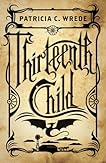 Thirteenth Child by Patricia C. Wrede
My review
rating: 4 of 5 stars
Patricia C. Wrede earned my undying loyalty with 1990’s
Dealing with Dragons and the ensuing Enchanted Forest Chronicles, the continuing adventures of tomboy princess Cimorene, teddy-bear-patterned magic carpets, rabbits-turned-donkeys-turned-blue, flying, incorporeal-donkeys, and villainous, magic-stealing wizards whose Achilles heel turns out to be lemon-scented soapy water. In
Thirteenth Child, the first installment in a promised “Frontier Magic” series, she won me over again.
Thirteenth Child is set in an alternate-reality 1800s United States where manifest-destiny-bound pioneers have more than the usual hardships to deal with: beyond the Great Barrier Spell that protects communities east of the Mammoth River, they’re vulnerable to all manner of creatures both “ordinary” (mammoths, saber cats) and magical (Columbian sphinxes, steam dragons, swarming weasels). Traveling magicians from fancy East-Coast colleges patrol the frontier, trying their best to protect the settlements, but out West is a risky life.
Wrede’s narrator is Eff, a girl seemingly doomed by her birth order: though her twin brother Lan, as the seventh son of a seventh son, is a natural magician of great power, her status as the eponymous thirteenth child is cause for dislike and suspicion Thirteenth children always go bad, you see, and from early childhood Eff finds herself blamed for whatever goes wrong nearby. While her large family is supportive, humbugging the superstition, Eff herself is afraid the rumors are true, and grows up constantly on guard for signs of evil in herself. When the family moves to Mill City, a flourishing community right across the river from the very Wild West, it seems like a new start for Eff—but can she escape her birthright?
Yes,
Thirteenth Child is
Little House on the Prairie with magic, thus targeting the precise demographic I’ve cherished since the age of five. Wrede’s world-creation is great, combining homespun folkiness with a highly developed system of magic that includes diverse traditions: Avrupan, Hijero-Cathayan, and Aphrikan, all with different methods and strengths. The enchanted world is consistent and plausible. I look forward to more!
 Driving Like Crazy: Thirty Years of Vehicular Hellbending Celebrating America as it Ought to be-an Oil Well in Each Backyard, a Cadillac Escalade in Every ... Potentates Trying to Rope a Goat for Dinner by P. J. O'Rourke
My review
rating: 4 of 5 stars
One (well, me) occasionally hears the notion bandied about that conservatives aren’t funny. This is, of course, as reductive generalizations tend to be, complete and utter bunk; as incontrovertible evidence, I offer the sublime, wicked, merry-making stylings of Mr. P.J. O’Rourke. I defy anyone to read my all-time favorite chapter heading from
Parliament of Whores—“Our Government: What the Fuck Do They Do All Day, and Why Does It Cost So Goddamned Much Money?”—without respecting the snark, even if you’re not of his libertarian bent (his main problem with both major parties, it seems, is that they want to stop him having fun).
Perhaps
Driving Like Crazy is a good place to start, since it’s not overtly political at all: O’Rourke has for thirty years written automotive journalism for a variety of publications:
Car & Driver, Esquire, and
Rolling Stone, among others, and a lot of it’s collected here, from his 1978 “National Lampoon” piece which draws the conclusion that no car handles like a rented car (“You can go faster, turn corners sharper, and put the transmission into reverse while going forward at a higher rate of speed . . . than in any other kind. You can also park without looking, and you can use the trunk as an ice chest”) to his tongue-in-cheek defense of the SUV as an embodiment of the American spirit (“The real truth is that we need sport utility vehicles to carry our concealed weapons”). In between, he “discovers” NASCAR, drives a 1956 Buick Special from Florida to Los Angeles, goes off-roading in the Baja, on-roading in India, and despite having three children, stubbornly resists the practicality of a minivan.
My automotive knowledge is limited to gingerly refilling the various leaking fluids of my leviathan Mercury Grand Marquis, but even when O’Rourke dips into acronym-and-numeral car-nut talk, I never felt lost. The reason for this is that the man can sling a metaphor better than almost any writer I know. Re a Suzuki GS1100 motorcycle: “Any twist of the throttle put you in danger of being left there with empty bowlegs, like a Roy Rogers figurine after the dog ate the plastic Trigger.” Describing entrants in the California Mille, a road race that only allows cars that could have been driven in Italy’s Mille Miglia, which took place from 1927 to ’57: “There was an Aston Martin DBR2 showing compound curves beyond the dreams of Frank Gehry and a gill-slitted Maserati 200SI that could star in
Jaws IV if anyone were idiot enough to put it in the water.” In short, O’Rourke’s lively writing got me through a 250-page book about cars. CARS. If this can happen, there’s hope for a post-partisan America. One where everybody drives
really fast.
AND last but not least, though not reviewed:
Geek Love, Katherine Dunn
I read this for an on-line book club (the Onion's sister site The AV Club). It's about a carnival family where the parents decided, with the aid of drugs and radiation, to breed their own freakshow, and it's every bit as dark and perverse and glorious as that sounds.
First Impressions, Marilyn Sachs
A promising premise--a girl who identifies with
Pride & Prejudice's neglected, nerdy middle sister, Mary Bennett--that was abandoned almost immediately in favor of ho-hum YA nattering.
Sag Harbor, Colson Whitehead
My boss kept telling me I'd like this one, so I finally took it home: Yeah. It's about 15-year-old Benji's summer at his parents' beach house, in an upper-middle-class African-American community--it's about race and D&D and ice cream and manhood and reinvention, and it's summery like sand between your toes.
Right now I'm halfway through
Will You Take Me As I Am: Joni Mitchell's Blue
Period, by Michelle Mercer. It's all right. On tap: Blake Nelson's
Destroy All Cars--he wrote
Paranoid Park, which Gus Van Sant made into a movie (I should fact-check that, gimme a second--yup), and way back in the 90s, excerpts from his first novel
Girl were published in my beloved
Sassy magazine.
Whew.


