21 January 2012

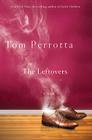
The Leftovers (Tom Perrotta)

Tom Perrotta's sneaky The Leftovers is the February read for Freebird Books' Post-Apocalyptic Book Club--while I never make it down to Red Hook for the meetings, I'm trying this year to keep up on the books. (Yes, I know it's January. But while I Really Really want to read Colson Whitehead's Zone One, I'm like #35 on the list at the library.)

I call it "sneaky" because it is, at heart, the kind of straightforward domestic literary novel I almost never read. Except for the looming sfnal premise that drew me in: three years before the main action takes place, millions of people all over the world just . . . disappeared. It wasn't a proper Rapture at all, as the remaining premillenial Christians point out sourly--heathens, Jews, Muslims, Buddhists, and all manner of sinners vanished as well as true believers. Perrotta never tries to explain what happened; instead, he simply explores a world that's suffered such a drastic and mysterious loss, both people who are forever changed and those struggling to recreate normalcy in the face of what becomes known as the Sudden Departure.

At the heart of the narrative are the Garveys: Laurie, who has abandoned her husband and children to join a cult called the Guilty Remnant, whose faith includes a vow of silence and constant cigarette smoking; Kevin, mayor of their small suburban town, tentatively starting a relationship with a melancholy woman whose entire family Departed; son Tom, who dropped out of college to follow Holy Wayne, a self-styled prophet with a predilection for teenage Asian girls; and seventeen-year-old Jill, a former A student fallen in with the worst crowd that will have her.

The Leftovers is largely a meditation on grief, what it does to individuals, families, and society. Which isn't to say that it isn't also funny in places, sweet in others. While it's only tangentially a post-apocalyptic novel, it's still a good one, I think in the very realistic-novel sense that would have made me shy away from the book without the improbable hook: the characters are fully, recognizably human, and their attempts to rebuild their lives wholly believable. I feel a little humbled by my liking it: perhaps this genre of "literary fiction" has some gems after all.

15 January 2012

REREADATHON!

My Christmas present to myself this year was oh-so-cheap and deeply appreciated: the guilt-over-taking-my-finger-off-the-pulse-free rereading of three wonderful books.

First, an upscale airplane read (which carried me through all my holiday-trip flights): Foucault's Pendulum (Umberto Eco), the labyrinthine, loopy tale of three editors who set out to create the ultimate conspiracy theory and succeed behind their wildest dreams. (Wow, is that the blurbiest sentence I've ever written?) It's a thriller by way of Rupert Giles' library, and the source of everything I know about kabbalah, the Templars, the Rosicrucians, folk religions of South America, etc., etc. for gobs of medievalist esoterica. And it's erudite in the way only the most formidable erudition can be, in that it's glorying goofily in the whole enterprise, playing fast and loose with logic in the name of narrative. So much fun!!

Then, brought down the room with Edith Wharton's The House of Mirth. Good grief, this book is a punch to the gut, but such a beautiful, elegant, necessary one, an indictment of a whole society by an insider. If you haven't read it--and you should, and you should also watch the movie with Gillian Anderson, because she nails it--it follows lovely Lily Bart, brought up to crave opulence and to live beyond her means, through her slow downward spiral out of society and into failure. She's an amazing, conflicted character. There's this core to her that wants something--anything--more than what the turn-of-the-twentieth-century New York deems appropriate for a beautiful woman. She longs for love yet can't accept a marriage without money, knowing her luxurious tastes would cause her to resent a man who couldn't indulge them. A part of her, though, chafes at the idea of marriage without love. Trapped between the two, she can only flounder, and a series of poor decisions ruins her chances for even a comfortable life. Her gradual failure is heartbreaking, because she's so likeable--and yet when she realizes she's a "useless person," she's absolutely right. She has no skills, no real talents. She is merely decorative--and once she ceases to serve that purpose, she's thrown out like a Christmas tree after New Year's. (For the other side of the coin, read Wharton's uproarious The Custom of the Country, which chronicles the meteoric rise in the same social milieu of scheming-to-the-point-of-sociopathic Undine Spragg. Ooh, look, come March you can get both with The Age of Innocence in a sexily-illustrated omnibus edition! Penguin Classics, I love you.)

And even though I first read it less than a year and a half ago, I fell madly in love with Skippy Dies all over again. Like I wrote previously, it "hits the sweet spot for me between bleak and hilarious, between epic and hopelessly mundane." Paul Murray evokes both pubescent coming-of-age and the modern second attempt at maturity that (in a First World-y way) occurs in our late twenties with such pathos, such brutal precision, it would be unbearable if he weren't also so freakin' funny. I'd forgotten the variety of narration he uses, sometimes subtle ones, as when conversation is sometimes set off with quotation marks and sometimes only with commas--and second person present, the trickiest, weirdest POV, makes frequent and effective appearances. His sentences swell and ebb expertly, punchily short following protracted ones, comma-strewn but carefully constructed. Oh, and this time I actually marked a few particularly gorgeous passages, so you don't have to just trust me when I enthuse about the glory of the prose! Here ya go:
  • "[An elderly priest] in his black raiment looking like a single downward stroke of the pen, a peremptory, unforgiving slash through the error-strewn copybook that is the world."
  • "[Ruprecht] gently lowers Optimus Prime into a kind of metallic crib [part of a machine intended to bridge eleven-dimensional space]. And there, for a moment, on his knees by the foil-lined pod, he bides--like Moses's mother, perhaps, with her bulrush basket on the banks of the Nile--gazing reflectively at the robot's painted eyes, thinking that to do anything, epic or mundane, bound for glory or doomed to failure, is in its way to say goodbye to a world; that the greatest victories are therefore never without the shadow of loss; that every path you take, no matter how lofty or effulgent, aches not only with the memory of what you left behind, but with the ghosts of all the untaken paths, now never to be taken, running parallel . . . "
  • "You know, you spend your childhood watching TV, assuming that at some point in the future everything you see there will one day happen to you: that you too will win a Formula One race, hop a train, foil a group of terrorists, tell someone 'Give me the gun', etc. . . . Gradually the awful truth dawns on you: that Santa Claus was just the tip of the iceberg--that your future will not be the rollercoaster ride you'd imagined, that the world occupied by your parents, the world of washing the dishes, going to the dentist, weekend trips to the DIY superstore to buy floor-tiles, is actually largely what people mean when they speak of  'life'. Now, with every day that passes, another door seems to close, the one marked PROFESSIONAL STUNTMAN, or FIGHT EVIL ROBOT, until as the weeks go by and the doors--GET BITTEN BY SNAKE, SAVE WORLD FROM ASTEROID, DISMANTLE BOMB WITH SECONDS TO SPARE--keep closing, you begin to hear the sound as a good thing, and start closing some yourself, even ones that didn't necessarily need to be closed . . ."

I really can't wait to read everything Murray writes for the rest of his career--I won't be able to think of Irish literature without calling up his name.
07 January 2012

Fletcher Hanks: comics weirdo

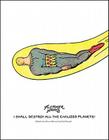
I admit to being both ignorant of and fascinated by superhero comics--never read 'em as a kid, and am utterly daunted by the DC/Marvel decades of shifting mythology, but gosh they can be fun (and yeah, I prefer "fun" to "gritty." Which is why I prefer Superman to Batman. And the Flash to either). They can also be weird as all get-out, particularly in the embryonic early days (late 1930s-early 1940s). And I have it on good authority that no one was weirder than Fletcher Hanks, whose complete works can be found in the Fantagraphics volumes I Shall Destroy all the Civilized Planets! and You Shall Die By Your Own Evil Creation!.

Hanks wrote and drew for two years, 1939 to 1941, and then disappeared--apparently to a life of itinerant alcoholism--but he left behind comics which are stupefying in their brutal simplicity. Here's the usual plot: villain up to no good (alien, rogue scientist, fifth column) manages to put his evil plan into motion for long enough to kill quite a lot of innocent people before one of Hanks' bizarre heroes shows up and puts a poetic-justice stop to it. His two favorite good guys are Stardust, a space wizard who's also a crimefighter, and Fantomah, an ostensibly beautiful damsel and protector of the jungle who, uh, turns into a skull when she's angry. But then there's also several stories featuring Big Red McClane, who's just a logger who punches people a lot, kind of a bulkier Mark Trail without any pretense of loving nature.

The most confounding thing about Hanks' comics is how completely unappealing they are. The art is clunky, the characters deformed, the colors are garish, the writing strewn with deus ex machina (usually in the form of "rays"--disintegrating, anti-gravity, oxygen-destroying, etc.). And yet, I kept reading, and  I don't think comics historians are wrong for calling him a genius and a visionary. What's there, I think, is a mind totally uncluttered by influence--an unsophisticated, kitchen-sink kind of mind, playing with a sort of frantic delight with this new medium, just throwing things at the panels to see if they stick. Even the way he draws people--just barely recognizable as human through our brain's awesome trick of pareidolia--grows on you, especially the corrugated masks of his villains (at first, with my Old-Timey Media goggles on, I'm like, "Is this racist somehow?" but I think it's more misanthropic) and the way Stardust can grab said baddies by the shoulder and just crumple up their bodies like a coat. Essentially: Hanks' comics are fun in a pure, childlike way, like running around with your arms out pretending to be an airplane or stomping about making T-rex noises (which I certainly never do when I'm grumpy. Ask anybody!). Exactly what I look for in a superhero comic.

06 January 2012

O HAI 2012

You know what? I'm not even going to go into my (valid) excuses for the blog's falling off last month. Because they are boring. And because wild inconsistency is, after all, the God-given right of the amateur blogger. Instead, I'll just do better in the future--one of my (extremely specific yet unambitious) goals-not-resolutions for 2012 is two blog posts a week. I can do that! I read at least two books a week!

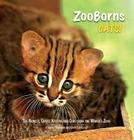
Still, since the year's off to a rough start, I'm beginning with the softest of softie-woftie softballs that is ZooBorns Cats!: The Newest, Cutest Kittens and Cubs from the World's Zoos, a surprise gift from a friend at Simon & Schuster waiting in my work locker when I returned from vacation last week. This adorbs little photobook showcases "the largest number of juvenile feline photos from different species assembled in one publication." Which is essentially all you need to know, and much more articulate than my own limb-flailing THE BEBEH KITTEHS WITH THEIR ITSLE EARS AND FEETS AND NOSES!!!

The coolest thing about ZooBorns Cats!, though, is its sheer range: of course, there are lion and cheetah and tiger cubs, but there are also little-known wild felines from around the world. From South America, there's the Geoffroy's cat, which will stand up on its high legs to survey its surroundings; the round-eared guiƱa; the dexterous margay, which can rotate its ankles 180 degrees--useful for an almost entirely arboreal existence. Asia has the fishing cat, the teensy-weensy rusty-spotted cat (adults top out at 3.5 pounds!), and the Iriomote cat, the remaining 100 wild individuals of which live only on a remote Japanese island. And there's the Pallas's cat, the jungle cat, the pampas cat, the sand cat, the oncilla . . . really, more kittens on heaven and earth than my wildest dreams of floofiness.

Most of them are endangered--through habitat loss and interbreeding with domestic cats. So all this cuteness has a cause: not only to bring attention to animals we've never even heard of, but to spur us to support the efforts of zoos and other conservation organizations to keep these animals from disappearing. Some of these babies represent years of work, money, and science--proceeds from the book go to the Association of Zoos and Aquariums Conservation Endowment Fund. (The ZooBorns website doesn't limit itself to just cats, or even to mammals: the top story right now is an Andean condor chick named--very appropriately--Muppet.) Donating to which, I realize, needs to be another goal for the year.

20 December 2011

YA break!

So I'm in the midst of my first December working retail at Grand Central Terminal--this week, leading up to Christmas and Chanukah, is proving to be a doozy. Luckily, there's young adult literature to smooth over the rough spots.

Withering Tights, Louise Rennison: By the hilarious author of the Confessions of Georgia Nicolson series, which I really must read the rest of, WT starts off a new series with a bang! This one centers of Tallulah Casey's misadventures at a quirky-to-say-the-least performing arts school on the Yorkshire moors. Plenty of adolescent romance, humiliation, and sarcasm for all! And I loved that Tallulah realizes her true talent lies in comedy--since some still contend that women can't be funny (hello, the late Christopher Hitchens!), it's nice to see a different attitude pitched to young'uns.

Everybody Sees the Ants, A.S. King: Purchased on the strength of King's Please Ignore Vera Dietz, one of my favorite books of last year. Wasn't disappointed--Ants is a mix of raw and witty, with an otherworldly undercurrent. Its narrator, Lucky Linderman, has been mercilessly bullied by Nader McMillan since he was seven. Eight years later, he's lost faith entirely in the world of adults to protect him: not his distant father, not his obsessive mother, certainly not the school administrators and therapists concerned more with his joke-y proposal to do a social studies project surveying students with the question, "If you were going to commit suicide, what method would you choose?" His sole trusted authority figure is that of his grandfather and namesake--and that only happens in dreams, where he tries time and time again to rescue him from a Vietnamese prison camp. This mission, given to him by his beloved grandmother on her deathbed, blurs the line between fantasy and reality, as Lucky brings back objects from the dreamworld into his real, miserable life. The book is funny and haunting by turns, at a level rarely reached in soi disant adult literary fiction.

Darker Still, Leanna Renee Hieber: Finished off my streak with a good old-fashioned YAP break. Hieber's debut is a Dorian Gray-ish teen paranormal romance, wherein mute New Yorker Natalie Stewart falls in love with Lord Denbury, imprisoned by sinister forces inside a portrait, against the backdrop of 1880 Manhattan and the still-new Metropolitan Museum of Art. I liked but didn't love it--I wish that everything hadn't been just as it seemed, the bewitched lord righteous, his bewitcher so blandly evil. I need a little ambiguity in my heroes and villains.

19 December 2011

The Possessed (Elif Batuman) . . . and a wee Christmas-y Gogol!

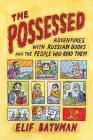
Missed the last meeting of the Russian year of the WORD Classics Book Group due to dumb ol' stupid ol' fun-ruining illness, but I did read the book, and it was indeed a fitting cap to the Tolstoy-Dostoevsky-Gogol experience. Elif Batuman's The Possessed is a joyous journey through the lives and peculiarities of people of all nations who find devote themselves to Russian literature. Batuman is an unapologetic member of their ranks, having almost accidentally found herself a Stanford graduate student in comparative literature.

But though she's got a wonderful analytical mind, her prose evades even a whiff of academic density. The long essay that (in three parts) forms the backbone of the collection, "Summer in Samarkand," details her experiences ostensibly learning Uzbek in that still-exotic city--it's a laugh-out-loud funny culture-shock story, a historical introduction to the complexities of Central Asia (as she learned later, "Uzbek" was not even a defined ethnicity or language until the Soviets decided it was in the early twentieth century), and a guide to a literary tradition largely unknown (and honestly somewhat nebulous) outside of the region. Her writing's lovely, witty, smart--even if you've never read a word of those daunting Russians, I highly recommend the book.

I also read, in the spirit of the season, a wee New Directions paperback edition of Gogol's novella, "The Night Before Christmas," a decidedly un-Moore-ish romp featuring the devil, guilty husbands hiding in sacks, and caroling for sausages. It's a fun, frisky folktale, and just cemented my opinion: Gogol is totes my favorite Russian writer!

18 December 2011

Broken Glass Park (Alina Bronsky)

(Ugh, so many apologies for the involuntary hiatus. Was laid low for nearly two weeks by an illness whose main symptom was constant, debilitating fatigue. GUESS HOW FUN THIS MADE DECEMBER RETAIL. Am now almost recovered, whether from a persistent virus or anemia, I'm not sure.)

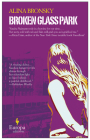
Broken Glass Park was Russian-born German author Alina Bronsky's first novel, and while it's not the black-comic masterpiece that is The Hottest Dishes of the Tartar Cuisine, it shares with that book an unforgettable, fully realized, fully habitable voice. Here, it's teenage Sascha Naimann, a Russian immigrant to Germany struggling to deal with her mother's violent death at the hands of her stepfather. She's filled with helpless rage and guilt--but she's also smart as a whip and fiercely protective of those she loves, notably her half-brother and -sister, who've lost not only their mother but the father who shot her. A confrontation with the editor of a newspaper that published a supportive interview the killer leads to a relationship with him and his son that shifts unsettlingly between familial and romantic. Bronsky writes Sascha's raw, conflicting emotion, her simultaneously jaded and naive view of the world, and her understandably dark sense of humor with the ease that only comes with great talent--the kind that makes me want to learn German so I can see how much more amazing it is in the original. But since that continues not to happen? Much thanks to Tim Mohr and Europa Editions for bringing Ms. Bronsky into my world! (And thanks to the Europa Challenge blog for giving me still more incentive to keep reading this terrific publisher.)
 
Creative Commons License
Muse at Highway Speeds by http://museathighwayspeeds.blogspot.com is licensed under a Creative Commons Attribution-NonCommercial-NoDerivs 3.0 Unported License.