So this review was going to start with a rant about how Dorothy Sayers's tour de force
Gaudy Night was out of print and what is WRONG with people, but I've learned that Harper is
reissuing it in October with a swank new cover, which has simmered me back down. This is a book which should not be lost: partly because it contains a crucial chunk of her twenty-year Lord Peter Wimsey narrative, in the form of the BEST PROPOSAL EVER (fictional division, of course; don't get het up there, Andersen). Still more vital, it portrays the lives and travails of educated women in the first decades of the twentieth century, from their own perspectives--an experience that must not be forgotten. I hesitate to call it the first feminist detective novel, not being an expert on either category, but it is certainly early, and important.
If you're not familiar with Lord Peter Wimsey, you are in for a treat come October. The short version is: Bertie Wooster but fiercely bright, and a detective. With a monocle! As charming a character as he is, though, he appears in
Gaudy Night for maybe a tenth of its pages--and detecting proper takes up maybe a fourth. Most of the book centers on Harriet Vane, a mystery writer Peter saved from the gallows when she was accused of murdering her lover in
Strong Poison. He fell madly in love with her, and had been proposing to her on a regular basis--and being refused--for years since. He does nothing so unpleasant as stalk, never fear, merely sending a polite letter every month or so; she continues to demur not from antipathy, but from resentment over being indebted to him for her life, and an unwillingness to award herself as recompense for said debt.
The book takes place in 1935, as Harriet returns to Shrewsbury College, Oxford, for her class reunion, dubbed the "Gaudy." After a weekend of friendships rekindled (and regretfully outgrown) with former classmates and dons alike, she's drawn back to the city of dreaming spires by a pleading letter from the Dean, who knows her dabbling in detection and needs discreet help. There's been a rash of nasty happenings on Shrewsbury campus: poison-pen letters, obscene drawings, vandalism, including a bonfire of students' gowns in the quad and the wanton destruction of Miss Ludgate's long-in-the-making manuscript on her new theory of prosody. The culprit seems bitterly hostile towards unmarried academic women, branding them as harpies and man-eaters . . . and timing and circumstances point to one of Shrewsbury's own.
So why not call in the police, or at least alert the highers-up at Oxford? Well, the very nature of the pranks--their pointedness at the collegiate woman--begs for as little publicity as possible. Women were only granted the right to receive degrees from Oxford in 1920 (Sayers, like Harriet, was one of the first women to do so), and they're still regarded as at best unusual and at worst unnatural. Harriet fumes when the gown-burning incident is reported by a London paper as an "Undergraduettes' Rag" investigated by the "Lady Head":
Women, of course, were always news. Harriet wrote a tart letter to the paper, pointing out that either "undergraduate" or "woman student" would be seemlier English than "undergraduette," and that the correct method of describing Dr. Baring was "the Warden." The only result of this was to provoke a correspondence headed "Lady Undergrads," and a reference to "sweet girl-graduates."
This sort of sniggering is exactly why Shrewsbury's academics want an investigation on the quiet. And while Harriet protests she's hardly a professional, she's happy to oblige by moving back onto campus, ostensibly to research a biography of Gothic writer Sheridan Le Fanu. And she's fallen back in love with the intellectual life, after years away in unlucky love and literary society. In between incidents with Shrewsbury's mad prankster, Sayers luxuriates in conversation, between smart and opinionated women, about who they are, who they could be, what society demands of them and what it should. It's wonderful to read, both as artifact and as sad testimony to what hasn't changed.
For a mystery novel,
Gaudy Night seems to have little at stake--no murder, no theft of material property (beyond those academic gowns, weighty with their symbolic value). But what's threatened is far more precious: the right of women to pursue the examined life, to find paths other than marriage and family. Though Harriet finally accepts Peter's suit at novel's end, it's from a realization that he does, indeed, view her as an equal, a mind to rival his own. His successful proposal demonstrates this--he addresses her not only in Latin, but in a snippet from an Oxonian degree-granting ceremony, calling her
magistra, literally, a woman with a master's degree. It's, uhm, really, really romantic. Almost as romantic as having my attention distracted from a book of
Onion sports reporting to be proposed to in front of my whole family on Christmas morning . . .
 The City & the City, China Miéville: First read this as an ARC back in '09, my first exposure to Miéville's work, and I felt lukewarm towards it at the time. While it's still not my favorite (I think Perdido Street Station and Kraken tie for that honor), I did better appreciate it this time around. It's a police procedural with a spec-fic premise that's way harder to explain than it is to read in his capable narrative: it's set in the cities of Beszel and Ul Qoma (in the same nebulous part of the world as Jan Morris's Hav), which occupy the same physical space but have wholly separate governments, languages, and history--an inhabitant of either city grows up learning the art of seeing and unseeing, realizing in an instant whether a given passersby or building or vehicle is in his own city, able to be acknowledged and interacted with, or the other, whereupon it officially does not exist to them. Looking over the border is the direst of crimes, calling out the mysterious force called Breach. In this singular environment, Beszel policeman Tyador Borlu finds himself investigating a unique and complicated murder: the victim, American archaeology student Mahalia Geary, was found in Beszel . . . but killed in Ul Qoma. And when he finds out that she was obsessed with legendary third city Orciny, the mystery deepens. Miéville doesn't so much blend genres here as snort derisively as the very notion that blending is even necessary; like his cities, they're already part of each other, no matter how fiercely we to keep them separate.
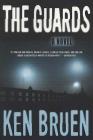 The Guards, Ken Bruen: First in a series narrated by Jack Taylor, alcoholic ex-Garda (i.e., member of the Garda Síochána na hÉireann, Ireland's police force), now picking up private-eye work in between blackout benders. What makes this fast-moving Irish noir work for me, despite its pretty standard setup, is the lyricism of its writing--almost a prose poem in places. Bruen's habit of dropping the beginning of a quote to the paragraph after its tag provides a literal rise and fall to his characters' speech that I found especially effective.
 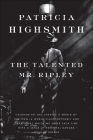 The Talented Mr. Ripley, Patricia Highsmith: This classic thriller hardly requires my praise, but I'm givin' it anyway. Tom Ripley is a small-time con artist sent to Europe by a college acquaintance Dickie Greenleaf's father, who pays his way hoping that Tom can persuade Dickie to leave his idle life painting in Italy to come home and join the family shipbuilding business. Instead, Tom decides to not just emulate Dickie, but become him, killing him and stealing his identity and the money that goes with it. Ripley's often referred to as a sociopath, but I think he's an even more chilling creature--completely blank, a malleable substance that reconfigures itself to the specifications of what those around him expect or want, not so much a personality as a gallery of masks.
 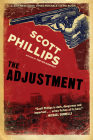 And speaking of sociopaths, there's no other way to describe Wayne Ogden, the cheerfully amoral narrator of Scott Phillips pitch-black Midwestern noir The Adjustment. He's just returned to 1946 Wichita from years as a supply sergeant in Europe, a job he used as front for a black-market gamut of drug dealing, pimping, and thievery. Now he's back to work in "public relations" for Collins aircraft, his primary duties being to keep the company's head in booze and hookers, and cover up the consequences. This is not a book for anyone who needs a protagonist with any
glimmer of redeeming qualities--being in Ogden's head is a harrowing and
repugnant experience--but apparently I've no such requirement, because I loved it. Been meaning to read Phillips for ages--though he lives in St. Louis now, he's a Wichita boy, with a native's nonchalant knowledge of the city, and he's a Watermark Books favorite (I grinned goofily when Ogden makes a phone call "in the back of Gessler's drugstore on Douglas," said storefront now being occupied by Watermark). On the wall of their basement autograph galley, he's drawn himself looking chagrined at a podium, thinking to himself, "Dear God, there's not a single paragraph in here appropriate for a mixed audience. Next time I'm writing a NICE book." I, for one, am glad he hasn't.
And speaking of sociopaths, there's no other way to describe Wayne Ogden, the cheerfully amoral narrator of Scott Phillips pitch-black Midwestern noir The Adjustment. He's just returned to 1946 Wichita from years as a supply sergeant in Europe, a job he used as front for a black-market gamut of drug dealing, pimping, and thievery. Now he's back to work in "public relations" for Collins aircraft, his primary duties being to keep the company's head in booze and hookers, and cover up the consequences. This is not a book for anyone who needs a protagonist with any
glimmer of redeeming qualities--being in Ogden's head is a harrowing and
repugnant experience--but apparently I've no such requirement, because I loved it. Been meaning to read Phillips for ages--though he lives in St. Louis now, he's a Wichita boy, with a native's nonchalant knowledge of the city, and he's a Watermark Books favorite (I grinned goofily when Ogden makes a phone call "in the back of Gessler's drugstore on Douglas," said storefront now being occupied by Watermark). On the wall of their basement autograph galley, he's drawn himself looking chagrined at a podium, thinking to himself, "Dear God, there's not a single paragraph in here appropriate for a mixed audience. Next time I'm writing a NICE book." I, for one, am glad he hasn't.