28 December 2010

Post-Christmas blowout!

Greetings from the heart of Snowmageddon! And welcome to a hidden pitfall of working from home (been doing freelance editorial stuff for McGraw-Hill, and I kind of love it): no excuse not to work even when everyone else has a snow day. Oh wells.

BOOKS!!

The Somnambulist, Jonathan Barnes: One of the first fellow-bookseller recs I received when I started working at Watermark in, uhm, March 2008. The perils of the front list! For the first few hundred pages I kept worrying I was reading the wrong book after all--I was waiting for two characters to show up who didn't till very near the end--which anxiety messed with my enjoyment of the tale of a bit. You won't have that problem: you'll just rollick through a Holmesian, Poe-esque, relentlessly tongue-in-cheek murder mystery about an no-longer-young magician-detective; his hulking, silent, impervious, only-milk-drinking assistant (the Somnambulist of the title); circus freaks, secret agents, assassins, and Coleridge cults, all tied together by an enigmatic narrator who admits outright he plans to lie at times. Quite fun.

Flannery, Brad Gooch: More informative than enlightening. But really, as long as you quote her, it's impossible to write a bad biography of Flannery O'Connor, right?

Missing You, Metropolis: Poems, Gary Jackson: I won this in an Twitter contest in re: literary superheroes!!! Courtesy of the always fascinating Graywolf Press and my superheroine alter ego, The Editrix, pictured herewith:

[Note phalanx of red pens, and first edition Elements of Style. Not pictured: feline sidekick, The Independent Claws.] The book's a first collection by a poet from Topeka (Kansas--another connection! Though my only Topeka experience is field trips to the State Capitol. Look up our mural of John Brown: it is CRAZY SAUCE), strung together with comic-book ruminations, kind of a Midwestern, African-American Fortress of Solitude. It also reminds me of Krypton Nights, the (now sadly out of print) first collection by a poetry guru of mine, Bryan Dietrich. I think there's a strong argument to be made that the DC/Marvel universe is as important a source of shared experience and metaphor for our culture as, say, Homer was for the ancients: comic books are where our modern myths are created and revised.

Mr. Toppit, Charles Elton: Another Twitter score, sort of--went to my first-ever invited-as-a-book-blogger publisher-sponsored happy hour towards the end of last month (I skipped D&D for it! HUGE!!), at the charming and gracious behest of Other Press. Who, I'll have you know, published TWO of my favorites of the year: The Origin of Species (Nino Ricci) and Sarah Bakewell's brilliant Montaigne bio How to Live. The event was a great time, got me thinking more about expanding readership and reach and influence or whatever of this blog...and I totally forgot to pick up a copy of this novel, which I'd heard good things about. Luckily, Ms. Terrie Akers was kind enough to send it out, with impressive turnaround. Thanks!

(OK, one more side note: "Charles Elton" is just a straight-up Austen-character name, isn't it? I love it.)

Mr. Toppit--another winner. Hooked me with the first line: "And out of the Darkwood Mr. Toppit comes, and he comes not for you, or for me, but for all of us." EEK! It's the last line of what turns out to be the last book in "The Hayseed Chronicles," a series of Narnia-esque children's books that languish in obscurity until their British author, hit by a car, spends his dying moments with an American tourist adrift in her own life, who latches onto the books--and the man's family--and single-handedly creates a posthumous frenzy, turning the books into classics, their mysterious, sinister antagonist, Mr. Toppit, into a cultural icon. The author's son Luke, transmuted into the books as the main character, grows up twisted by his perceived notoriety; his older sister is similarly warped by the Chronicles' omission of her existence. It's a wonderful, dark story about stories, about the sometimes sick but inevitable feedback loop between books and life. And Elton does a marvelous job constructing the book's nesting flashbacks and revelations, both in the reality of the Haymans and the fiction of the Hayseeds--we read just enough of the Chronicles' weird and menacing prose to want to read them all, and at the same time to feel that we've read them before. I think Mr. Toppit deserves all the praise and exposure lavished upon the seriously disappointing The Magicians: better written, better plotted, infinitely more heartbreaking (and yes, wickedly humorous at times, as all the best dark books are).

Over Sea, Under Stone, Susan Cooper: Again, a fitting follow-up--a real beloved, dark children's classic. No clue how I missed the Dark is Rising sequence in my Narnia-and-Prydain days. I'm told that the conventional wisdom is actually to skip this one and head straight to the eponymous #2, and I can see why (this book is OBSESSED with logistics and maps and directions, which I am constitutionally incapable of following), but oh well, I'm a completist, and here at least I've been introduced to the Arthurian good-vs.-evil struggle that I presume makes up the narrative arc of the next four books.

See you next year.

12 December 2010

Fangs, gangs, perpetual trains!

[Yes, I am SO PROUD of this title. Trademark me, 2010!!!]

December reading:

Dracula's Guest: A Connoisseur's Treasury of Victorian Vampire Stories, ed. Michael Sims: Out this summer, somehow slipped down to the bottom of my stack! I'm (probably not surprisingly) a peruser of vamp fiction from way back, since encountering Anne Rice at the tender age of 13 (and the less said about those books' influence on my burgeoning sexuality, the better) (the word for this kind of pointing-out-by-saying-you're-not-pointing-it-out, btw, is paralipsis! Second most useful word I learned this week--also, from a random Wikipedia article, "demonym," meaning the proper term for a person from a particular place, e.g. Kansas, New Yorker.). Really, this is one reason Twilight irritates me so much, because I KNOW VAMPIRES and these are NOT vampires, lady!!!
Returning to the anthology at hand: Dracula's Guest is a well-curated collection of tales, interspersed with some fun "non-fiction" accounts of Eastern European vampirism. Besides the obvious suspects (Polidori, Stoker), Sims collects some forgotten gems of bloodsucker lore--my favorite was "Let Loose" by Mary Cholmondeley, which involves an aficionado of early English fresco accidentally awakening a baneful (and slightly hilarious when revealed) presence. Other highlights include Mary Elizabeth Braddon's "Good Lady Ducayne" (and if you haven't read her Lady Audley's Secret, it's one of the Great Trashy Novels), a tantalizing excerpt from James Malcolm Rymer's penny dreadful Varney the Vampyre (can we say "overwrought"? And "can't stay in one tense within a paragraph"? Yes, we can), and yes-slightly-related Aleksei Tolstoy's "The Family of the Vourdalak."

Liberation: Being the Adventures of the Slick Six After the Collapse of the United States of America, Brian Francis Slattery: Heard M. Slattery read with Charles Yu at WORD back in yikes, September? accompanying himself on banjo: a dreamlike, sci-fi-by-way-of-folk experience and a perfect setup for the novel itself, which is a freewheelin' hippie road trip bluegrass heist dystopia about trying to correct the sins of history personal and national--and viciously, sardonically funny, and brutal and multicolored and just a great ride! Loved it.

Iron Council, China Mieville: Good luck of the draw reading this right after Liberation, as they're both Westerns at their heart. Remember what I said about Mieville's playing with The City as concept? In this, the city is also a revolution, and a constant escape--a train, seized by striking employees and set out across the continent over decades, laying tracks before it just long enough to travel over them, their path constantly disappearing in their wake. It's connected to New Crobuzon, the sick-at-heart metropolis introduced in Perdido Street Station, literally and figuratively. And as usual, I have trouble even discussing Mr. Mieville's work in any kind of intelligent fashion, as I am just so overwhelmed by his genius, and so aware of my inability to accurately reflect it in my own prose. Endlessly enjoyable.

And in sad news, coming full circle back to fangs: Francesca Lia Block's YA-vamp-bandwagon entry, Pretty Dead, is just awful. She's begun writing like a pale imitator of herself at her height, with none of the lushness or the heart that made her so important. Oh well, we'll always have Weetzie.

27 November 2010

Beginnings of Best of 2010!

Things these lists are: tentative (as I just started a book this morning that made it onto the list--what if I read something awesome on New Year's Eve?!?), in reverse order of when I read 'em instead of any kind of ranking, needlessly idiosyncratic. Links go back to original mention on this blog, in an omphaloskeptical sort of way.

FRONTLIST (i.e., published in 2010)

BACKLIST

The best thing I read this week...

...this line from The Best of Everything:

"[She] had never been poor enough to feel the fright of poverty but only its small annoyances."

Most perfect phrasing ever of my quasi-adult lifestyle. For instance, this morning I handwashed a thrift-store cashmere sweater in the bathroom sink with shampoo because I can't afford dry-cleaning. Not exactly rent-or-food stuff...I mean, I'm unemployed, but I won't be for long. I have savings. Frugality for me is a virtue and not yet a necessity--I let people buy me drinks at bars. I don't go to movies. I haven't gotten that Nancy Drew tattoo.

And the whole novel was marvelous--the stories of young women in publishing in New York in the early fifties. One way to judge the success of a novel is whether I talk aloud to the characters, and here I kept shaking my head and muttering "He's never going to marry you, honey." And I was right, of course. If only one could be so clear-headed about one's own relationships.

I also finished The Outward Room: going to drag out the old adjective "lyrical" for the writing. It turned out much better for the protagonist than I'd feared. And it's always fascinating to read a novel from a time when Italians weren't yet white.

This morning I started reading Suzanne Rivecca's short story collection Death is Not an Option; I'm not even through the title story and I've already added it to my work-in-progress best of 2010 list. I'm such a sucker for effortlessness of voice!!

Literary cultures.

I loved this article in Slate about the parallel literary establishments of the MFA and NYC worlds. I shan't recap, because you should really go read the article, but I did a lot of nodding. I dropped out of my poetry MFA after a year, when I realized I was only having fun in my modern dance class, and I guess I'm on the periphery of the NYC market now, as a local bookseller. What bugged me most about my MFA program (besides my cohorts' lack of knowledge of, or interest in, much lit besides contemporary poetry, most of which bores me silly) was the willful blindness to the business end of things. I can write on my own (not that I really do anymore...), but I've no clue how to query, how to locate likely lit mags, how to format a goddamn manuscript--and the trade is just completely ignored--all something we're somehow supposed to pick up on our own. Or not, maybe--as the article points out, the point of an MFA is to secure your position in the MFA system; in other words, to get a teaching job. And that's fine if you want to teach. But I never did; nor was I any good at it. And I don't think there's any connection between writing well and teaching well, so it's a shame the teacher-writer is the standard.

But then, I see the shortcomings of the NYC publisher model, too, of course: business corrupts art, art avoids business, etc. I feel much more hopeful than my academic-y brethren & sistern about American Letters, though, as great books are being published all the time, whether heralded or no. Really, the three letters I'd offer as the literary culture producing the best work right now are SF/F. I know it's a pet topic with me that realism is limiting, and I find myself loving realistic novels all the time--but when the NYTBR positive review of How to Live Safely in a Science Fictional Universe has to explicitly say "sometimes sci-fi can tell us more about our lives through metaphor than straight-up realism" IN THIS DAY AND AGE WHEN IT HAS ALWAYS BEEN TRUE?!?! It seems it still bears repeating.

24 November 2010

Happy Yam Day!

 (I don't like turkey. Also, today is my cat Juliana's 16th birthday, which is how I justify this otherwise gratuitous kitten adorableness pic:
OMG TINY EARSES) So, books! First, miscellaneous items of interest perhaps: I don't think I have plugged The Word Detective in this particular forum, but it is a must for all etymological hobbyists and "didja know"-ists. 'Twas knowledge garnered from Mr. Evan Morris that allowed me yesterday to explain the origin of the word "bailiwick." See, "-wick" is an old English place-name suffix (as in Warwick, etc.), and the "baili-" comes from "bailiff," who in ye olden times was a sheriff's assistant, a fairly powerful official. A "bailiwick" was simply his jurisdiction. Easy-peasy.

Also! A friend of my Aunt Laura & Uncle Kurt had a combination birthday costume party/ private showing of the new Harry Potter movie! She is not 10 years old, as such an event would suggest. I love grown-up theme parties. Here are slightly blurry iPhone pics of the two, as Minerva McGonagall and Mad-Eye Moody, I hope obviously respectively:

In things-I-am-actually reading news, I finished up the last novel from my September looking-for-a-job-at-indie-bookstores spree, Françoise Sagan's Bonjour Tristesse--very nouvelle vague, but less fun than Bad Marie--just in time to start another somewhat dispiriting rounds of visits (not going to bitch about the Strand at length. Just not at all a fun place to work). This time I'm trying to actually start living/spending like I'm unemployed, that being the actual situation, but I did pick up a copy of Perdido Street Station at St. Mark's Bookshop as a Christmas gift for my brother-in-law, who I don't think reads this blog: last Xmas gift to purchase! Are you jealous? I had a beautiful cupcake with a perfect buttercream rose at Books of Wonder; the frosting tasted just like the one my family makes for our traditional red velvet birthday cake, which most places top with cream cheese frosting, which is several steps less awesome. And at the cluttered, cozy, holy-crap-I-feel-like-I'm-in-London used bookshop Alabaster (so far the only place that "might" be hiring), I picked up a used copy of Rona Jaffe's The Best of Everything, which the lovely Stephanie Anderson is trying to get every woman in publishing to read. I started this on the train, as my previous read, Millen Brand's The Outward Room (NYRB Classics; snagged a galley as it has an introduction by Peter Cameron, one of my favorite contemporary dialoguists), while good, was dwelling on the travails of a bipolar girl looking for work in New York City during economic hard times. Liiiiiiittle close to home. Best of Everything is great--reminds me a lot of The Group, though written earlier and set later.

Other stores I visited without purchase, though I made sure to snag a bookmark for my "installation piece," by which I mean I'm gonna hang 'em on my wall: The Mysterious Bookshop, Posman Books in Grand Central Station, The Center for Fiction (mostly a subscription library/ lecture & workshop series, with a tiny, tiny fundraising bookshop), and Shakespeare & Co. (Broadway & Washington Place location). I am totally awarding myself a fake FourSquare badge for visiting the most New York indie bookstores this year. Go me! And that perfect job (that's somehow not WORD but perfect anyway) is out there. I may just have to be more artist-pursuing-a-dream about it and see if I can make some cat food money doing temp clerical work while I wait. Julie likes Innova, and that doesn't come cheap.

21 November 2010

A day late...

...but not a dollar short, I don't think. Let's try Sundays and Wednesdays for a bit, yes? They've always seemed good twice-a-week days to me.

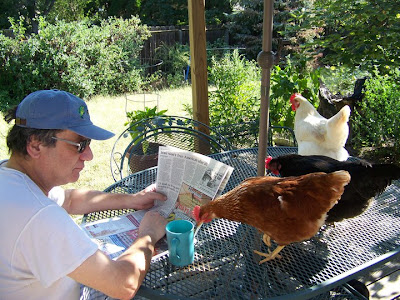
So The Tenant of Wildfell Hall!!! Every bit as amazing as Agnes Grey was disappointing. I read this novel because of these chickens:

These lovely ladies free-range about my folks' backyard (here they're having Saturday morning coffee with my dad). And because my family is my family, their names are (L-R) Emily, Charlotte, and Anne, after the Bronte sisters! And because they'd ended up with those names, my parents couldn't resist taking my bookselling-alma-mater Watermark's Bronte Sisters Challenge last summer. And while Penguin Classics saw fit to stick Agnes Grey in with Jane Eyre and Wuthering Heights like it was Anne's best novel, the inimitable, indefatigable Mark Bradshaw (love you, Mark!) sussed out Tenant and told everybody in the Challenge it was his fave of all the Bronte novels. So Mom and Dad read and agreed. And golly, so do I!!!

Tenant centers on an excruciating portrait of a terrible marriage, at a time (1848) when such things weren't talked about--but it's worth as much as a novel as it is a historical curio, due to the relentless detail of how poor Helen Huntingdon, head turned by a handsome rogue and sure she can settle him down (how hope springs in the 18-year-old heart), finds herself tied indissolubly to a childish drunk, more interested in carousing in London with his bros than getting to know his son--he's jealous of the baby for diverting her attention from him; later, he amuses himself by getting the toddler drunk and teaching him swear words. Helen's first-person narrative (told in diary form) is a masterpiece of emotional doublethink: she vacillates between love and hate, between determination to force her husband to reform by endless patience and love and the fear that her beloved son will grow up just like his father. It's like following Lydia and Willoughby home, and a marvelous antidote to the "romanticizing [of] douchey behavior" (I love you, Kate Beaton) practiced by Anne's sisters, and by extension generations of writers for women (*cough Stephenie Meyer cough*). It's a must-read. Thank you, chickens!
 
Creative Commons License
Muse at Highway Speeds by http://museathighwayspeeds.blogspot.com is licensed under a Creative Commons Attribution-NonCommercial-NoDerivs 3.0 Unported License.